The State of LLMs — October 2026

Executive summary
In October 2026 the frontier is a five-way tie within about 5 points: Claude Opus 5.5 leads the Artificial Analysis Intelligence Index (an independent composite of 10 evaluations, explained under Benchmarks compared) at 57.6, with Claude Sonnet 5.5, Muse Wonder Full, Claude Fable 5.1, GPT-6 Astra, Gemini 4 Argon and Muse Wonder packed between 52 and 56. The ranking matters less than three other facts: who you can actually call, what a task costs, and how often the model invents answers.
The two names in the news:
- Meta Muse Wonder shipped today, 12 October 2026. It is Meta's first true frontier model and is callable now on the Meta Model API at $4 / $20 per million tokens. Its stronger sibling, Wonder Full, is locked inside paid Muse Code plans.
- Gemini 4 Argon was announced on 30 September 2026 (the week before last, not last week). It is real and benchmarked but not callable: only cyber defenders in Google's Fairwind Program have it. What Google actually shipped last week was the enterprise Gemini agent (8 October), EmbeddingGemma 2 and Nano Banana 2.1 — products and small models, not a new flagship.
Three structural shifts define the period:
- Gated releases are now normal. Anthropic's Mythos 5.1, OpenAI's GPT-5.6-Cyber and Google's Argon all went to vetted security partners first. A launch post no longer means an API key.
- Cost per task replaced price per token. Models with identical rate cards differ 3–10x per task because some write far more tokens.
- Hallucination rate became a buying criterion. On the AA-Omniscience test, rates range from 15% (Argon) to 73% (Fable 5.1) among top models — and the most accurate model is not the most honest one.
All figures below are as published on or before 12 October 2026; most benchmark tables come from the vendors themselves and should be read as best-case.
The landscape: four labs at the frontier
Anthropic, OpenAI, Google and now Meta each have a model within about 5 index points of the top, and all four shipped a flagship in the last six weeks. xAI (Grok 4.7) and Moonshot (Kimi K3) sit one tier below; DeepSeek, Zhipu and Alibaba lead open weights.
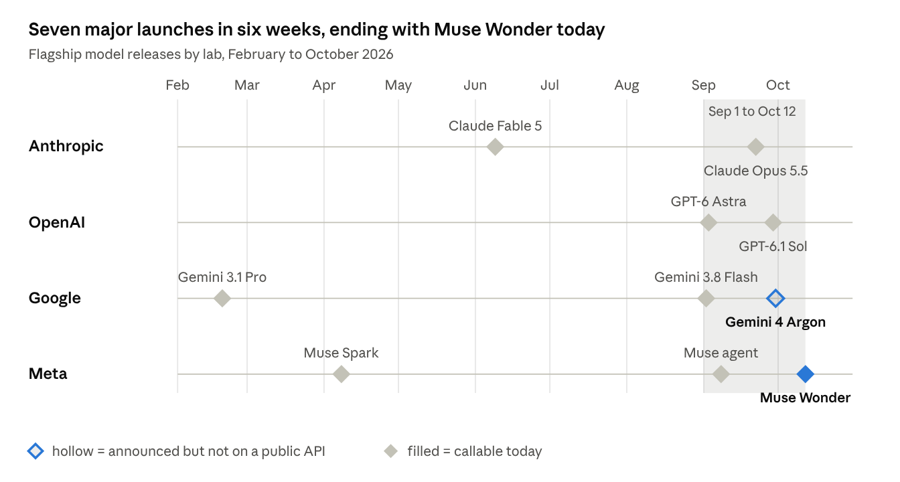
The September cluster is the story: Google's Gemini 3.8 Flash and OpenAI's GPT-6 Astra opened it, Anthropic's Claude Opus 5.5 and OpenAI's GPT-6.1 Sol followed, and Argon and Wonder closed it. Argon is the only one of the seven you cannot call.
Meta Muse Wonder: Meta's first frontier model
Muse Wonder (muse-wonder-1.0) landed on 12 October 2026 and scores 52.4 on the Artificial Analysis index — level with GPT-6 Astra, about 5 points under Claude Opus 5.5. It is the first Meta model since the Llama 4 stumble that belongs in a frontier comparison without qualification. Meta newsroom · TechCrunch
Where it sits in the Muse family
"Muse" is a brand for a whole stack, which causes confusion. The pieces, in release order:
Date (2026) | Release | What it is |
|---|---|---|
12 Oct | Muse Wonder / Wonder Full | Frontier reasoning models, internal codename "Watermelon" |
23 Sep | Muse Realtime Avatar | Embodiment layer shown at Connect |
8 Sep | Muse (the agent) | Consumer personal agent running in a cloud VM, US only, 18+ |
2 Sep | Muse Spark 1.3 | Mid-size model that powers the Muse agent |
10 Aug | Muse Glimmer | 30B open-weight model, Apache 2.0 |
5 Aug | Muse Code + Spark 1.2 | Terminal coding agent (macOS, Linux, Windows) |
7 Jul | Muse Image / Muse Video | Image model shipped ($0.01/image); Video still unreleased |
8 Apr | Muse Spark | First Meta Superintelligence Labs model, codename "Avocado" |
Source: OrcaRouter's Muse family index, Axios on Muse Spark, Axios on the Muse agent.
Technical profile
- Context: 1,048,576 tokens, no long-context surcharge.
- Modalities: text, image, video, audio and PDF in; text out.
- Reasoning effort: adjustable from "minimal" to "max".
- Training: a larger base model trained at Meta's gigawatt-scale Prometheus data center in Ohio. Meta has not published parameter counts.
- Active Memory: trained to carry user facts across conversations and recall them when relevant. On Meta's own MemoryBench it scores 85.6%, ahead of Opus 5.5 (81.5%) and GPT-6 Astra (81.4%).
- Active Focus: trained to retry alternative approaches when a task stalls, instead of returning to the user.
Benchmarks worth trusting
The independent numbers tell a more modest story than Meta's own table. On Artificial Analysis, Wonder (API) scores 52.4 and Wonder Full 55.8, versus Opus 5.5 at 57.6 and Sonnet 5.5 at 56.0. The standout is honesty: Wonder's AA-Omniscience hallucination rate is 26.5%, roughly half that of Opus 5.5 (58.6%) or GPT-6 Astra (51.3%). Its weak spot is terminal coding — 52.0% on Terminal-Bench 4.0 against 59.6% for Opus 5.5. Handy AI's launch analysis
Caveats: every Meta number was run at max effort, most agent rows are Meta's own evals, and Meta's comparison chart omits Sonnet 5.5, which beats the API model at half the price. The model card says Meta could not rule out the unmitigated model reaching its high-risk chemical/biological threshold, so it ships with classifiers.
Availability — what you can really use
Variant | Where | Price |
|---|---|---|
Muse Wonder | Meta Model API, Muse Code | $4 in / $0.20 cached / $20 out per 1M tokens |
Muse Wonder Full | Muse Code only (not on the API, even at max effort) | $50 or $200 per month plans |
Muse agent app | Wonder coming "soon", subscribers first | $20 or $100 per month; free tier runs Spark 1.3 |
The API price is identical to Claude Opus 5.5, despite Meta's claim of pricing "meaningfully below" rivals. CNBC · Android Headlines
Google: Gemini 4 Argon, and what actually shipped last week
Google's new flagship, Gemini 4 Argon, was announced on 30 September 2026 and is still not callable by ordinary developers or subscribers as of 12 October. It is the first Gemini above the Flash tier in over seven months, after Gemini 3.5 Pro never shipped. Google launch post · TechPilot status check, 12 Oct
Gemini 4 Argon — technical profile
- Context and output: 1M tokens in, and 1M tokens out — up from 64K output on the previous generation. No other frontier model offers this; GPT-6.1 Sol caps at 128K. A new API feature, Long Decode Continuation, resumes very long outputs across calls.
- Modalities: text, image, video and speech in; text out.
- Positioning: long-horizon software engineering, legal/finance knowledge work, and defensive cybersecurity.
- Price: $2 / $10 per million tokens introductory, then $4 / $20; cached input 95% off.
- Independent score: 52.6 on Artificial Analysis (high effort) — level with GPT-6 Astra, about 5 points under Opus 5.5.
- Honesty: 15% hallucination rate on AA-Omniscience, the lowest of any leading model. It gets there by declining more, not by knowing more (50% accuracy versus Astra's 63%).
- Prompt-injection resistance: 0.7% attack success on Gray Swan's indirect-injection test, versus 1.0% for Opus 5.5 and 8.5% for GPT-6 Astra.
- Token appetite: about 62K output tokens per task versus 27K for Astra, so the cheap rate card does not translate into a cheap task.
Google's own 19-row table has Argon leading 14 rows, strongest in knowledge work (Harvey Legal Agent 19.6% versus 3.8% for Opus 5.5) and long context (84.2% on GraphWalks 256K–1M). It trails on terminal coding: Opus 5.5 leads Terminal-Bench 4.0 by 9 points and GPT-6 Astra leads FrontierSWE v2 by 10.5. eesel benchmark breakdown
Who can use it
- Now: vetted cyber defenders (governments, healthcare, telecom) in the Fairwind Program, some without cyber guardrails.
- Next, no date: paid Gemini API customers and Google AI Ultra subscribers.
- Later: everyone else.
There is no public model ID in the Gemini API model list; calls to gemini-4-argon return 404. Bloomberg also reported internal skepticism at Google about Argon's real-world coding.
What Google actually released last week (5–11 October)
Date | Release | Relevance |
|---|---|---|
8 Oct | Gemini agent (Gemini at Work) | Enterprise "universal agent" in Workspace and Gemini Enterprise; give it objectives, not instructions |
6 Oct | EmbeddingGemma 2 | Open, on-device multimodal embedding model for offline RAG over text, image, audio, video |
6 Oct | Nano Banana 2.1 GA | Image generation and editing model on the Gemini API |
9 Oct | Gemini app tier change | Free tier drops to Flash-Lite; Pro and Ultra keep Flash and Gemini Pro |
For developers, the Google models you can build on today remain Gemini 3.8 Flash (2 September; $0.75 / $3.75, doubling on 1 January 2027), Gemini 3.5 Flash-Lite, and Gemini 3.1 Pro Preview (February). Releasebot Google log · Gemini tier change
Benchmarks compared
On the independent Artificial Analysis index the top eight models span only 57.6 to 51.8 — a 6-point band. What separates them is honesty and cost, not raw score.
What the Artificial Analysis Intelligence Index measures
The Artificial Analysis Intelligence Index is a single 0–100 score that an independent benchmarking firm computes by running every model itself, under the same prompts and settings, across 10 evaluations. It is the most useful cross-vendor number here because Artificial Analysis does not take the labs' self-reported scores. All index figures in this article are from version 4.3.2.
The score is a weighted average of four categories, deliberately tilted toward agentic work:
Category | Weight | Evaluations (weight) | What it tests |
|---|---|---|---|
Agents | 30% | AA-Briefcase (15%), GDPval-AA (10%), AutomationBench-AA (5%) | Multi-week knowledge-work projects, 44 occupations' real deliverables, SaaS workflow automation via REST APIs |
General | 30% | AA-Omniscience (15%), GDP.pdf (10%), AA-LCR (5%) | Factual knowledge with a penalty for guessing, reasoning over long PDFs, ~100K-token multi-document questions |
Coding | 20% | Terminal-Bench 4.0 (10%), SciCode (10%) | Shell-based software and sysadmin tasks, scientific Python that must pass unit tests |
Scientific reasoning | 20% | Humanity's Last Exam (10%), CritPt (10%) | Frontier academic questions, unpublished research-level physics problems |
One detail matters for this article: AA-Omniscience feeds the index twice — accuracy (10%) and one minus the hallucination rate (5%). A model that guesses confidently loses index points, which is why the hallucination rates in the chart below come from the same source.
Why it is reasonably reliable
- Run independently. Every model is evaluated by Artificial Analysis on identical harnesses, not copied from launch posts. Its Muse Wonder numbers matched Meta's own chart, and it measured Gemini 4 Argon directly ahead of public release.
- Standardized settings. Zero-shot prompts, fixed temperatures (0.6 for reasoning models), the maximum output budget each lab allows, and up to 30 retries on API failures.
- Repeated runs. Noisy evaluations are repeated (3x for Terminal-Bench and SciCode, 5x for CritPt and GDP.pdf) and scored as pass@1.
- Private test sets. Four of the ten evaluations are held out from the public, which limits training-data contamination.
- Published methodology. Prompts, graders, harness (Stirrup, open source) and version history are public.
Limits to keep in mind
- Text and English only. Image input, speech and multilingual ability are scored separately, so the index understates strongly multimodal models.
- LLMs grade LLMs. Several evaluations use frontier models from OpenAI, Google and Anthropic as judges, with three-judge panels to reduce self-preference bias. Bias is reduced, not removed.
- Effort setting changes the score. Figures here are at max or highest effort. Opus 5.5 scores 57.6 at max but 51.2 at medium, so compare like with like.
- Versions are not comparable. Evaluations are swapped and re-weighted between versions; a 52 on v4.3.2 cannot be compared with an older v3 score.
- It is a composite. A 6-point index gap can hide a 20-point gap on the one benchmark your workload depends on — hence the per-benchmark table further down.
Live scores: artificialanalysis.ai/models · Full method: Intelligence benchmarking methodology
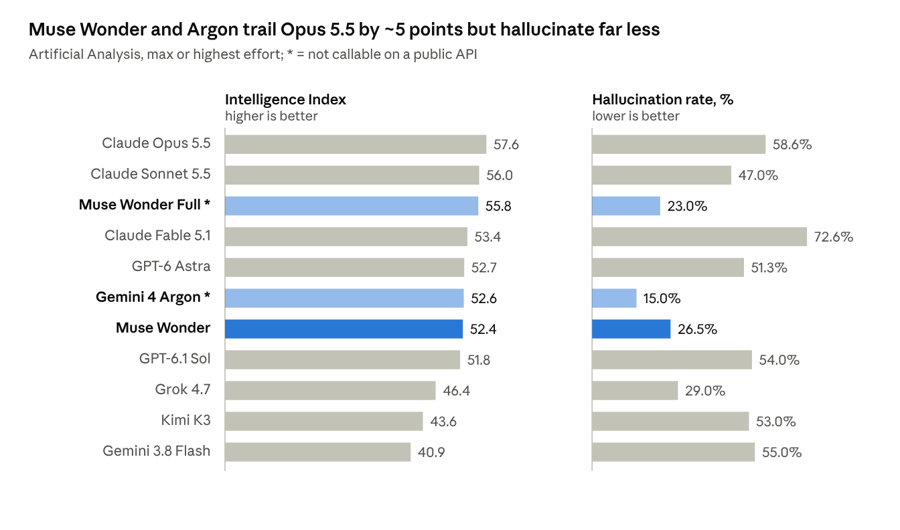
The most accurate model is not the most trustworthy one. Claude Fable 5.1 has the highest raw accuracy measured (67%) but also guesses when unsure, giving a 72.6% hallucination rate. Gemini 4 Argon is the mirror image: 50% accuracy, but it declines most questions it cannot answer. Muse Wonder lands near Argon on honesty while being callable today.
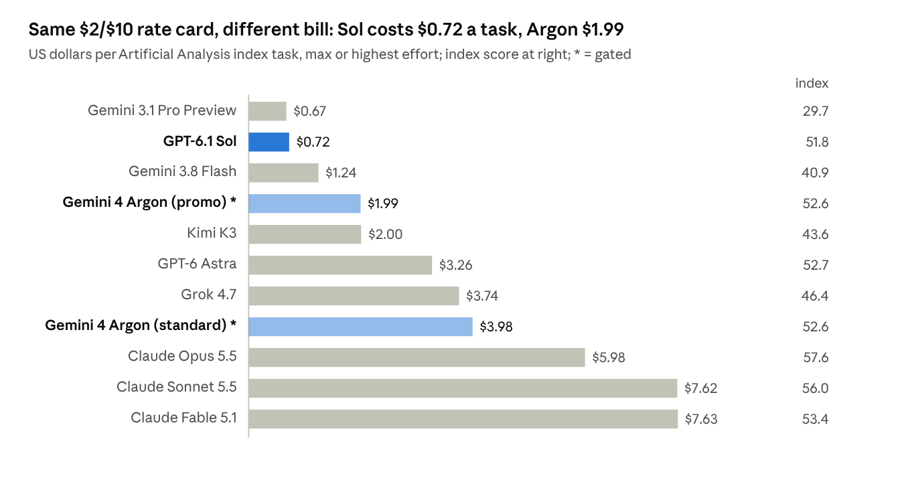
Per-token prices hide output volume. GPT-6.1 Sol and Argon share the $2 / $10 card, yet Argon writes about 62K output tokens per task against Sol's 38K, so it costs 2.7x as much per task — and 5.5x once its promo price ends. Opus 5.5 at medium effort (51.2 index, $1.34 per task) is the cheapest route to Argon-level results today.
Head-to-head on vendor benchmarks
These rows come from Google's and Meta's own launch tables, both run at max effort. Treat them as each vendor's best case.
Benchmark | Gemini 4 Argon | Muse Wonder | Claude Opus 5.5 | GPT-6 Astra | Claude Fable 5.1 |
|---|---|---|---|---|---|
Terminal-Bench 4.0 | 57.4% | 52.0% | 59.6–66.4% | 58.2–59.1% | 52.0–57.9% |
DeepSWE v1.1 | 77.9% | 78.8% | 74.2% | 74.1% | 67.4% |
AutomationBench | 51.3% | 39.1% | 41.2–42.5% | 41.4–41.6% | 31.4–32.1% |
Harvey Legal Agent | 19.6% | 10.0% | 3.8–4.2% | 5.4–8.6% | 6.4–6.7% |
FrontierSWE v2 | 55.0% | — | 62.3% | 65.5% | 56.3% |
GraphWalks 256K–1M | 84.2% | — | 66.8% | 71.8% | 65.0% |
Ranges show where Google's and Meta's tables report different numbers for the same rival — itself a reminder that harnesses differ. Google's table via eesel · Meta's table via Handy AI
Open-weight models: what you can actually self-host
The best open weights now trail the closed frontier by roughly 10–15 index points, and most of the top slots belong to Chinese labs. The real decision is not "best model" but hardware fit and licence. A 1.6T-parameter model is a cluster or a rented endpoint, not a box under a desk.
Model | Maker | Size / context | Licence | Best for |
|---|---|---|---|---|
Moonshot AI | ~1.6 TB weights, 1M ctx | Custom | Strongest open model on AA (43.6); best long-context reasoning measured (88.7%) | |
DeepSeek V4 / V4 Pro | DeepSeek | 1.6T total, 49B active, 1M ctx | MIT | Frontier-class open reasoning if you have a cluster |
DeepSeek V4.1 Flash | DeepSeek | Smaller V4 variant | MIT | Cheapest capable option ($0.15 / $0.60 hosted); 96% hallucination rate — keep away from customers |
GLM-5.2 | Zhipu AI | 1M ctx | MIT | Self-hostable long-horizon coding and agents |
Qwen3.5 | Alibaba | Wide size ladder down to 9B | Apache 2.0 (open tiers) | Most deployable sizes; the flagship Max tier is hosted-only |
gpt-oss-120b / 20b | OpenAI | 117B on one 80 GB GPU; 21B in 16 GB | Apache 2.0 | Best capability per GPU; easiest to put into production |
Mistral Large 4 | Mistral | ~1T, preview | Open weights | EU vendor; $0.68 / $2.09 hosted; mid-pack scores |
Meta | 30B | Apache 2.0 | Meta's open release now that Llama is no longer the flagship line | |
Gemma 4 / EmbeddingGemma 2 | Small | Gemma terms | On-device and edge; offline multimodal retrieval |
Sources: Context Studios self-hosting guide, Wavect open-weight comparison.
Two cautions. First, "Qwen" is a family: the open tiers self-host cleanly, but a plan that silently falls back to the hosted Max tier routes data outside your jurisdiction. Second, Llama 4 still has the deepest Western tooling ecosystem but carries the most restrictive EU licence terms of the group.
What is really available today
Of the ten headline frontier models, seven can be called on a public API today. Three cannot: Gemini 4 Argon (cyber defenders only), Muse Wonder Full (Muse Code subscriptions only) and Claude Mythos 5.1 (Project Glasswing partners only).
Model | Public API today | Consumer app | Price per 1M tokens (in / out) | Max output |
|---|---|---|---|---|
Claude Opus 5.5 (Anthropic) | Yes | Claude | $4 / $20 | — |
Claude Sonnet 5.5 (Anthropic) | Yes | Claude | $2 / $10 | — |
Claude Fable 5.1 (Anthropic) | Yes | Claude | $10 / $50 | 128K |
Claude Mythos 5.1 (Anthropic) | No — Glasswing partners only | No | — | — |
GPT-6 Astra (OpenAI) | Yes | ChatGPT | $10 / $50 | — |
GPT-6.1 Sol (OpenAI) | Yes | ChatGPT | $2 / $10 | 128K |
Grok 4.7 (xAI) | Yes | Grok | $2 / $6 (under 200K prompt) | — |
Muse Wonder (Meta) | Yes — Meta Model API | Muse, subscribers soon | $4 / $20 | — |
Muse Wonder Full (Meta) | No — Muse Code plans only | Muse Code ($50 / $200 per month) | — | — |
Gemini 4 Argon (Google) | No — Fairwind cyber defenders only | No (Ultra "next", no date) | $2 / $10 promo, then $4 / $20 | 1M |
Gemini 3.8 Flash (Google) | Yes, free tier | Gemini | $0.75 / $3.75 (doubles 1 Jan 2027) | — |
Gemini 3.1 Pro Preview (Google) | Yes | Gemini Pro / Ultra | $2 / $12 | 65,536 |
Kimi K3 (Moonshot) | Yes, plus open weights | Kimi | $3 / $15 | — |
Prices from the vendors' pages as compiled by eesel's alternatives review on 1 October and Handy AI on 12 October. Blank cells mean the limit was not stated in sources checked.
The practical rule: plan production work only on models with a published model ID. Argon's rollout has no date, and Google has historically opened access with only a few days' notice.
When to use each
Pick by workload, then by cost per task, then by hallucination behaviour — never by the headline index alone. Each recommendation below is a model you can call today unless marked.
Workload | First choice | Why | Runner-up |
|---|---|---|---|
Hardest reasoning, expert analysis | Claude Opus 5.5 | Top AA score (57.6); medium effort gives Argon-level results for $1.34/task | Muse Wonder Full (Muse Code only) |
Terminal-heavy coding agents | Claude Opus 5.5 or Sonnet 5.5 | Lead Terminal-Bench 4.0 (Opus 59.6–66.4%, Sonnet 63.6%) | GPT-6 Astra |
Very long coding runs, multi-hour agents | Muse Wonder | Leads DeepSWE (78.8%) and SWE-Marathon (53.1%) in Meta's table | Opus 5.5 |
Multi-step business workflows | Claude Sonnet 5.5 | 71.3% AutomationBench — best callable; same $2/$10 sticker as Argon | Opus 5.5 |
Legal, finance, long documents | Muse Wonder (today); Gemini 4 Argon (when it opens) | Wonder leads Harvey LAB among callable models; Argon leads all on legal and 1M-token context | Kimi K3 for self-hosted long context |
Answers where a wrong answer is costly | Muse Wonder or Grok 4.7 | Lowest callable hallucination rates (26.5%, 29%) | Sonnet 5.5 (47%) |
Near-frontier quality on a budget | GPT-6.1 Sol | 51.8 on AA at $0.72/task — about a third of Argon's cost per task | Opus 5.5 at medium |
Personal agent with memory across sessions | Muse Wonder | Active Memory; 85.6% MemoryBench | Claude with project memory |
High-volume, cheap, Google stack | Gemini 3.8 Flash | Free tier, $0.75/$3.75; add a strict "don't guess" rule | Gemini 3.5 Flash-Lite |
Data cannot leave your network | gpt-oss-120b, Qwen3.5, GLM-5.2 | Permissive licences, fit on 1–8 GPUs | DeepSeek V4 on a cluster |
Vulnerability research and patching | Fairwind / Glasswing programs if eligible | Gated models (Argon, Mythos 5.1) are strongest here | GPT-6 Astra or Grok 4.7 (tie Argon on CWE-bench, 68%) |
The industrial and IIoT angle
For plant-floor and SCADA-adjacent work, three properties matter more than leaderboard rank:
- Locality. OT data often cannot reach a public cloud. gpt-oss-20b runs in 16 GB of GPU memory and gpt-oss-120b on a single 80 GB card; Qwen3.5's 9B tier and Gemma 4 fit edge gateways. EmbeddingGemma 2 gives offline retrieval over manuals, drawings and alarm logs.
- Honesty under uncertainty. An agent that invents a setpoint or a tag name is worse than one that says "not found". Favour low-hallucination models (Muse Wonder, Grok 4.7, Argon when available) and enforce grounding: in an independent support test, five models invented 0 of 40 answers with a "don't guess, escalate" rule, and up to 4 of 8 without it. The prompt rule moved the result more than the model choice did.
- Long context for documentation. Equipment manuals, P&IDs and historian exports are large. Kimi K3 (open, 88.7% long-context reasoning) or a 1M-context API model handles whole document sets without chunking.
A workable pattern: a small local model for tag lookup, alarm triage and retrieval at the edge; a frontier API model for engineering analysis and code generation on sanitized data; and Python as the glue, since every vendor SDK listed here ships a first-class Python client.
Outlook and caveats
Expect Argon on the paid API and Google AI Ultra within weeks, Muse Wonder inside the Muse app for subscribers, and a security report from Meta. Prediction markets put a broad Gemini 4 release before December at roughly 85%.
Read every launch table with three discounts: vendors run their own model at max effort against rivals' reported numbers; self-built harnesses are mixed with public leaderboards; and the comparison set is chosen by the vendor (Meta omitted Sonnet 5.5; Google's table omits Grok). Independent indexes such as Artificial Analysis are the better tie-breaker, and your own evals on your own data are better still.
Sources
- Meta — Introducing Muse Wonder and Muse Wonder Full
- TechCrunch — Meta releases its first frontier model, Muse Wonder
- CNBC — Meta debuts Muse Wonder
- Handy AI — Model Drop: Muse Wonder
- Android Headlines — Muse Wonder Active Memory
- OrcaRouter — Meta Muse family index
- Axios — Meta debuts Muse Spark
- Axios — Meta debuts Muse personal agent
- Google — Gemini 4 Argon launch post
- eesel — Gemini 4 Argon benchmarks, pricing and access
- eesel — 9 Gemini 4 Argon alternatives
- TechPilot — Gemini 4 Argon access status, 12 Oct
- 9to5Google — Gemini agent at Gemini at Work 2026
- Releasebot — Google release notes, October 2026
- Let's Data Science — Gemini app tier changes
- Context Studios — Best open-weight LLMs 2026
- Wavect — Open-weight LLM comparison 2026
Benchmark methodology: Artificial Analysis — Intelligence benchmarking methodology (v4.3.2) · Artificial Analysis model leaderboard