The Kasato Maru

Built on the Tyne, owned by the Tsar, and remembered in São Paulo — the steamer of three flags that carried the first Japanese families to Brazil and now rests on the Pacific seabed.

Few ships have lived as many lives as the Kasato Maru. In forty-five years she flew the flags of three nations, answered to three names, and crossed paths with two of the era's great upheavals — the Russo-Japanese War and the Second World War. Yet she is remembered today for none of those things. She is remembered because, on a winter morning in 1908, she carried 781 hopeful Japanese farmers into the harbour of Santos, Brazil, and in doing so opened the door to what is now the largest community of Japanese descent anywhere on Earth.
This is the story of that ship: how she was built on the banks of the Tyne, how she briefly belonged to the Russian Tsar, how she became Japan's most famous emigrant vessel, how she was pressed into war and sunk by Soviet aircraft, and how she lingers still — a wreck in shallow Pacific water and an icon in the Brazilian imagination.
I · THE BUILD
A British hull for a South American trade
The vessel that would become the Kasato Maru began life in the northeast of England, at the Neptune Yard of Wigham Richardson & Sons in Newcastle-upon-Tyne — the same firm that, after merging with Swan Hunter in 1903, would go on to build the record-breaking liner RMS Mauretania. Laid down as yard number 362, she was launched on 13 June 1900 and completed that August at a cost of just over £97,000.
She was christened SS Potosí, after the legendary silver-mining city in the Andes — a name chosen for her intended career. Her owners meant to run her on the Pacific Steam Navigation Company's route to Valparaíso, Chile. But demand on that run collapsed, and almost as soon as she was completed the Potosí was sold off, her career redirected to the other side of the world before it had truly begun.
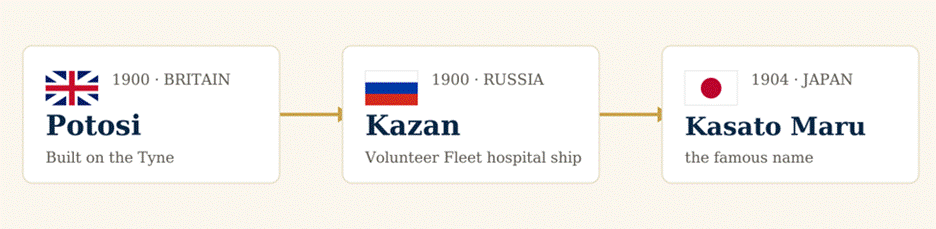
One hull, three flags. The steamer changed nationality twice in her first four years — from British-built Potosí to Russian Kazan to the Japanese Kasato Maru.
PARTICULARS OF THE SHIP
|
BUILDER |
Wigham
Richardson & Sons, Newcastle-upon-Tyne |
|
LAUNCHED |
13 June 1900
(as SS Potosí) |
|
TONNAGE |
approx. 6,000
gross tons |
|
LENGTH |
approx. 123 m
(405 ft) |
|
PROPULSION |
Twin
triple-expansion engines, two screws |
|
SERVICE SPEED |
approx. 13–14.5
knots |
II · THE RUSSIAN YEARS
From the Tyne to the Tsar — and a war beneath her keel
With the Chilean trade in doubt, the Potosí was sold almost immediately to the Russian Volunteer Fleet (the Dobroflot), a state-backed shipping organisation that doubled as a naval reserve. Renamed Kazan and registered to Odessa, she was put to work on the long run between the Black Sea and Russia's Far Eastern ports of Nagasaki and Vladivostok, and was fitted out to serve as a hospital ship.
That role placed her directly in the path of history. When the Russo-Japanese War broke out in 1904, the Kazan was caught up in the clash at Port Arthur, the besieged Russian naval base in Manchuria. There she was sunk — by most accounts, by Japanese naval action — and settled in the harbour. Victorious Japan salvaged the hull, claimed her as a spoil of war, and placed her under the Kure Naval District. She was raised, repaired, and given the name that would make her famous: Kasato Maru (笠戸丸).
A ship built for silver, owned by a Tsar, and raised from the mud of a captured harbour — all before she had carried a single emigrant.
The improbable first decade of the Kasato Maru
Her first task under the Rising Sun was a sombre one: she ferried Japanese soldiers home from the Manchurian front. But the war that had nearly destroyed her had also remade Japan into a confident, expanding power — one increasingly preoccupied with a problem of people rather than territory.
III · THE GREAT VOYAGE
781 emigrants and the opening of Brazil
By the early twentieth century, Japan's countryside was crowded and poor. Industrialisation had swelled the population while squeezing rural livelihoods, and emigration came to be seen as a release valve. The first destinations were Hawaii, the United States, Canada and Australia — but rising anti-Asian sentiment and exclusion laws were rapidly closing those doors. Japan's planners looked instead to South America, and above all to Brazil, where the coffee plantations of São Paulo were desperate for labour after European migration slowed.
The Kasato Maru had already been used as an emigrant carrier — to Hawaii in 1906, and to Peru and Mexico in 1907. Now, under charter to the Oriental Steamship Company (Tōyō Kisen) and operated on behalf of Ryō Mizuno's Imperial Colonisation Company, she was assigned the most consequential voyage of her life.
On 28 April 1908 she raised anchor at the port of Kobe amid fireworks, carrying 781 contracted emigrants — about 165 families — bound for the coffee estates of western São Paulo. Their supervisor, Shūhei Uetsuka, and the venture's director, Ryō Mizuno, would later be remembered together as “the fathers of emigration.” The crossing ran nearly 12,000 nautical miles over roughly 50 days, down through Southeast Asia, around the Cape of Good Hope, and across the South Atlantic — a passage of seasickness, heat and homesickness, but also of meals, songs and the first haiku ever composed on Brazilian waters.
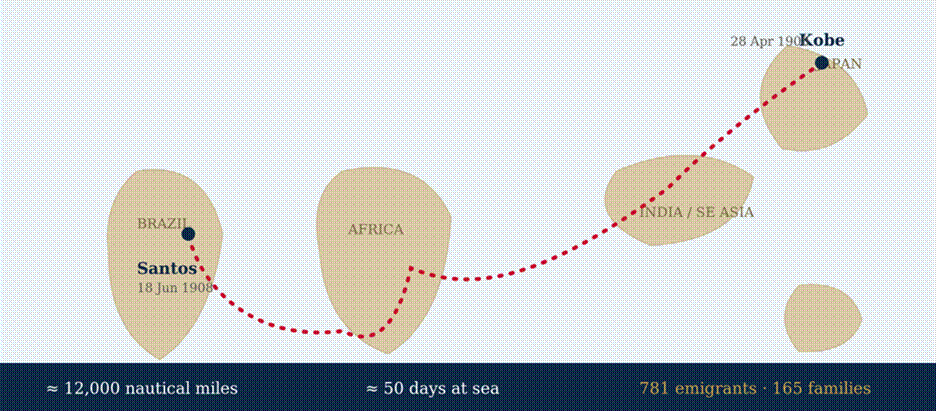
The 1908 passage. A schematic of the route from Kobe to Santos — south through Asia, around the Cape of Good Hope and across the South Atlantic. Map is stylised, not to scale.
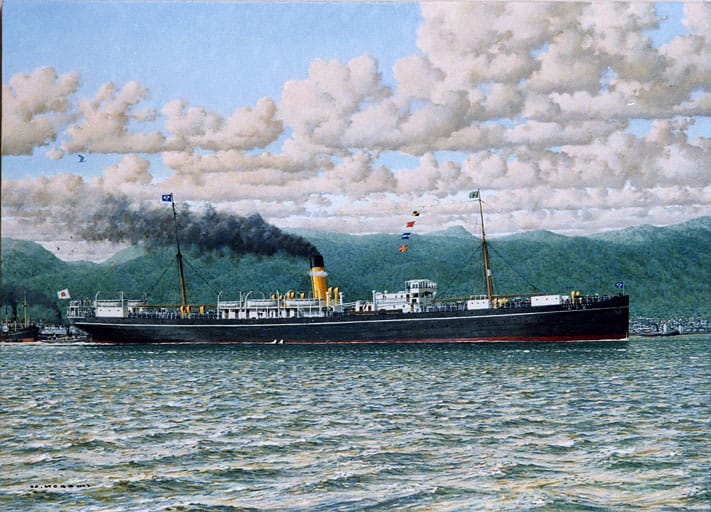
|
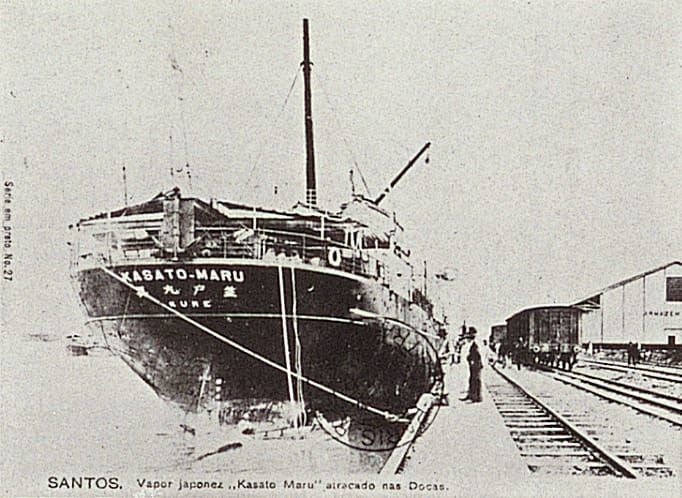
ARCHIVE PHOTOGRAPH The ship herself The Kasato-maru, the steamer that became the symbolic
“zero milestone” of Japanese Brazil. View: ndl.go.jp (National Diet Library
of Japan) |
On 18 June 1908, the Kasato Maru tied up at Wharf 14 in the Port of Santos. The date is now enshrined in Brazil as the Day of Japanese Immigration, and in Japan as the Day of Overseas Emigration. The arrival was not, strictly, the very first Japanese presence in Brazil — a few settlers had reached Rio de Janeiro earlier — but it was this organised, contracted group that began a continuous flow which never stopped.
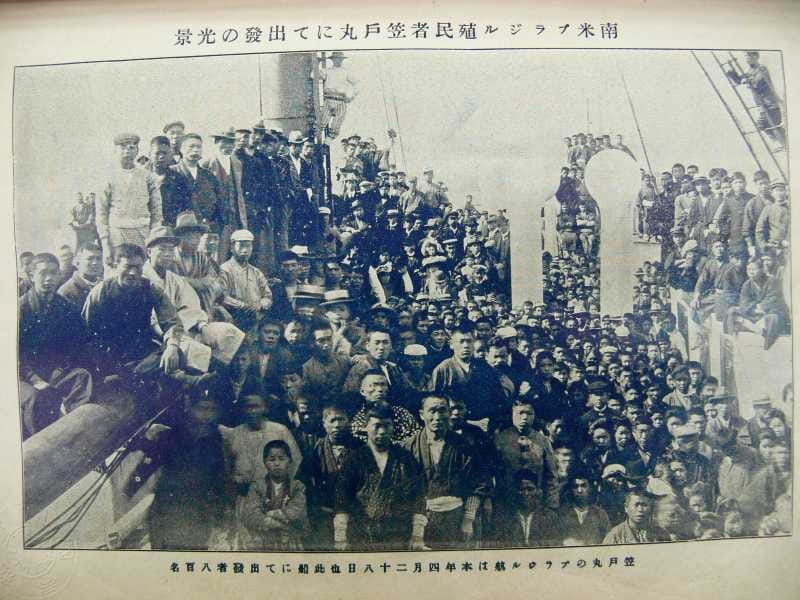
|
ARCHIVE PHOTOGRAPH The first 781 Members of the inaugural group of contracted Japanese
emigrants to Brazil aboard the Kasato-maru, 1908. View: ndl.go.jp (National Diet Library
of Japan) |
The reality that met them was hard. Wages on the coffee fazendas were low and conditions punishing; many fled their contracts within months, drifting into other work or, in time, buying their own land. Out of that struggle grew an extraordinary community. Japanese-Brazilian farmers transformed agriculture in São Paulo — introducing new crops and techniques — and put down roots that would make the Liberdade district of São Paulo the beating heart of the Japanese diaspora.
The Kasato Maru returned to Brazil only once more, as a freighter in 1917, under the Osaka Shōsen Kaisha (OSK) line that had by then acquired her. Her emigrant career bracketed neatly around the world's changing politics: she had carried the first contracted emigrants to Brazil in 1908, and in 1924 — the year the United States passed its Japanese Exclusion Act — she carried one of the last groups of emigrants to Hawaii.
IV · WAR AND SINKING
From fishing factory to a target off Kamchatka
The interwar decades scattered the Kasato Maru across an unglamorous variety of trades. Sold on again in the 1930s, she was converted into a floating fish factory — a sardine ship, a salmon ship and a crab cannery working the cold northern waters under the Shinkō Suisan and later Nippon Suisan fishing companies. It was a far cry from the fireworks of Kobe, but it kept the ageing steamer at sea.
When the Pacific War engulfed Japan, the navy reached for every available hull. In 1942 the Kasato Maru was requisitioned by the Imperial Japanese Navy and pressed into service as a support and supply ship, her decades of northern fishing experience now turned to wartime logistics in the seas off Japan's northern frontier.
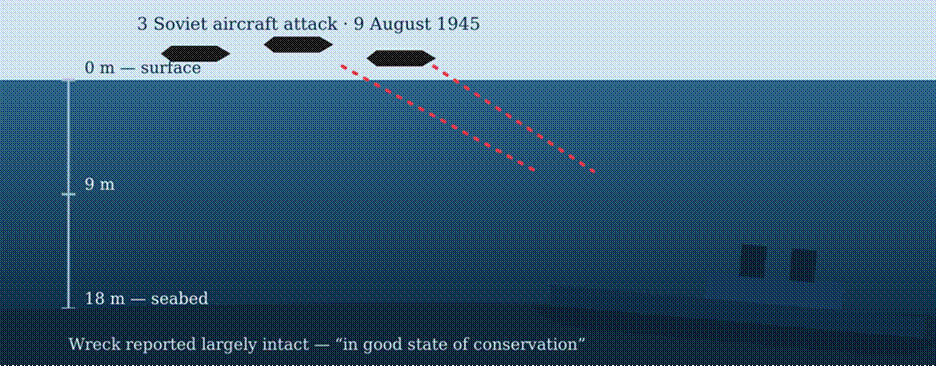
The end, and the rest. On 9 August 1945 the Kasato Maru was bombed by three Soviet aircraft and sank in shallow water near the Kamchatka Peninsula. She is reported to lie at roughly 18 metres' depth, largely intact. Diagram is illustrative.
Her end came on the very day the war reached Japan's north. On 9 August 1945 — the same date the Soviet Union declared war on Japan and the atomic bomb fell on Nagasaki — three Soviet aircraft attacked the Kasato Maru in the waters off Kamchatka. The assault lasted from about 11:15 in the morning until the early afternoon, and the old steamer went down. After forty-five years, three flags and a career that spanned hospital ship to coffee-emigrant carrier to crab cannery to naval auxiliary, she came to rest on the seabed near the Russian coast — sunk, as one Japanese account notes with some irony, by the very nation whose flag she had once flown.
V · THE WRECK & THE LEGACY
What remains, above and below the water
The Kasato Maru never vanished entirely. Records indicate that the wreck lies in relatively shallow water — about 18 metres deep — and in a notably good state of conservation, sheltered in the cold, low-traffic waters off Kamchatka. That combination has long made her a tantalising prospect: a famous, historically charged ship that, unlike most deep-ocean wrecks, sits within reach of divers.
Detailed, publicly documented dive surveys remain scarce, however — the wreck lies in Russian waters in a remote and politically sensitive region, which has limited open access and published exploration. The most concrete public initiative grew out of the 2008 centennial of the Brazil voyage. As part of those commemorations, a plan was floated to recover the ship's anchor from the seabed and preserve relics of the Kasato Maru in both Kobe and Brazil, turning the physical ship into a shared monument for the two countries her story binds together.
The centennial itself was marked with quiet drama. At 5:55 p.m. on 28 April 2008 — exactly one hundred years after she had cast off — every ship at anchor in the Port of Kobe sounded its whistle in unison, while a vessel put to sea carrying a “lamplight of friendship” lit at the former National Kobe Emigrant House, the very hostel where the 1908 emigrants had waited to depart.
|
2 M+ People of Japanese descent in Brazil —
the largest such community outside Japan |
June 18 Day of Japanese Immigration, observed
across Brazil |
≈ 18 m Reported depth of the wreck off
Kamchatka, said to be largely intact |
That legacy is the truest measure of the ship. The 781 souls of 1908 became the seed of a community now numbering in the millions, woven into Brazilian agriculture, business, food, sport and culture — and reflected back across the Pacific by the hundreds of thousands of Brazilian nikkei who later moved to Japan. The neighbourhoods of Liberdade, the festivals, the farms of São Paulo: all trace a line back to a single gangway in Santos.
“Kasato-maru is not just the name of a ship… it also symbolises a zero milestone of the eternal history of people of Japanese descent in Brazil.”
League of Prefecture Societies in Brazil, 1969
So the Kasato Maru endures in two places at once. One is the cold seabed off Kamchatka, where a British-built, Russian-owned, Japanese-flagged hull lies quietly intact, occasionally surfacing in plans and proposals to bring a piece of her home. The other is the collective memory of a nation she helped create — where, more than a century on, she remains the ship that started everything.
VI · TIMELINE
The life of the ship at a glance
|
1900 |
Launched on the Tyne as SS
Potosí by Wigham Richardson, for a South American trade she never entered. |
|
1900 |
Sold to the Russian
Volunteer Fleet, renamed Kazan, and used as a hospital ship out of Odessa. |
|
1904–05 |
Sunk at Port Arthur during
the Russo-Japanese War; salvaged by Japan and renamed Kasato Maru. |
|
1906–07 |
Carries Japanese emigrants
to Hawaii (1906) and to Peru and Mexico (1907). |
|
1908 |
Departs Kobe 28 April with
781 emigrants; arrives Santos 18 June — the founding voyage of Japanese
Brazil. |
|
1917 |
Returns to Brazil a final
time, now as a freighter under the OSK line. |
|
1924 |
Carries one of the last
emigrant groups to Hawaii, the year of the U.S. Japanese Exclusion Act. |
|
1930s |
Converted into a fishing
factory ship — sardine, salmon and crab — in northern waters. |
|
1942 |
Requisitioned by the
Imperial Japanese Navy as a wartime support ship. |
|
1945 |
Bombed by three Soviet
aircraft off Kamchatka on 9 August and sunk. |
|
2008 |
Centennial of the Brazil
voyage; Kobe's ships sound their whistles, and plans are drawn up to recover
and preserve her anchor. |
Sources
1. National Diet Library of Japan — 100 Years of Japanese Emigration to Brazil, column “The Ship Kasato-maru” (text and archival images). ndl.go.jp
2. “Kasato Maru,” Wikipedia (construction, ownership history, voyage and sinking details). en.wikipedia.org
3. “Wigham Richardson,” Wikipedia (builder history and the Potosí / Valparaíso origin). en.wikipedia.org
4. “Japanese immigration in Brazil” / “Japanese Brazilians,” Wikipedia. en.wikipedia.org
5. Marcelo do Carmo, “Kasato-maru and immigration to Brazil,” Suki Desu. skdesu.com
Note on sources: accounts differ slightly on a few figures — tonnage is variously given as about 5,300 to 6,167 gross tons, and the sinking site is described as near the Kamchatka Peninsula (Bering Sea / Sea of Okhotsk). The four illustrations in this document (the ship, the identity chart, the voyage map and the wreck cross-section) are original schematic graphics created for this feature and are not photographs; historical photographs are linked to the National Diet Library's digital archive.