The Old Man Mad About Art: Hokusai, the Great Wave, and the Original That Never Was
Thirty names, ninety-three addresses, a lightning bolt, a fire that burned everything he owned, and the most recognizable image in Japanese history — whose original drawing was destroyed on purpose before a single copy was ever sold.
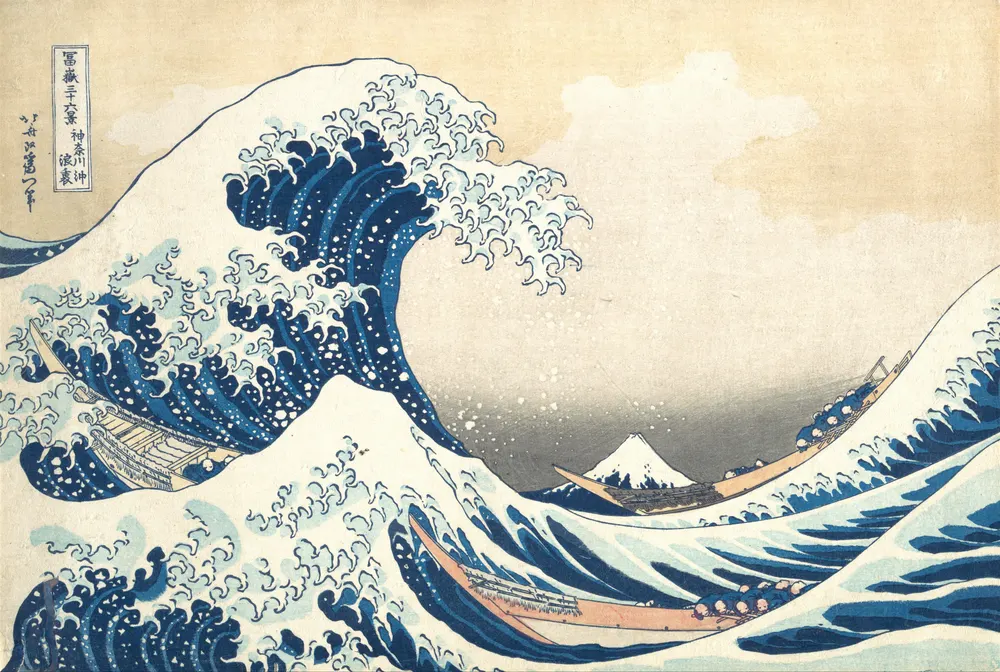
Thirty names, ninety-three addresses, a lightning bolt, a fire that burned everything he owned, and a global masterpiece whose original drawing was deliberately destroyed before a single copy was ever sold.
If you ask someone to name the most famous Japanese painting in the world, they will almost certainly describe The Great Wave off Kanagawa. And they will be wrong on the very first word.
It isn't a painting. There is no canvas hanging behind bulletproof glass in Tokyo or Paris where Katsushika Hokusai stood with a brush and laid down that Prussian blue water. If you go looking for the "original" Great Wave—the actual piece of paper Hokusai drew with his own hand around 1831—you will never find it. It does not exist. More strangely to a modern Western mind, it was destroyed on purpose, carved to pieces with steel knives before the public ever saw the image, as a routine step in how Edo-period commercial prints were made.
This post is about two linked stories. The first is the life and arc of Hokusai himself: a chaotic, impoverished, obsessive man who lived to eighty-eight, moved house ninety-three times because he preferred relocating to cleaning, changed his artistic name at least thirty times, and sincerely believed he hadn't learned how to draw properly until his seventies. The second is the physical reality of his masterpiece: why we only ever talk about prints of The Great Wave, what happened to Hokusai's original drawing, what happened to the cherrywood blocks that replaced it, and where the surviving impressions are today.
I · THE MAN WITH THIRTY NAMES
Ninety-three houses and an addiction to starting over
The man we call Hokusai was born in Edo (modern Tokyo) in October or November 1760, in the Katsushika district east of the Sumida River. His childhood name was Tokitarō. Later, he claimed his biological father was a mirror-maker for the shogun's court, though he may have been born to a concubine and adopted into the artisan Nakajima family. Either way, he grew up around hands that worked wood, metal and glass.
By fourteen he was apprenticed to a woodblock carver (horishi), spending four years learning what a chisel can and cannot do to a plank of mountain cherrywood. That technical detail matters. Most ukiyo-e ("pictures of the floating world") designers only drew with brushes and left the carving to workshop specialists. Hokusai knew from his teens how wood grain resists a blade, where fine lines snap under pressure, and how ink sits in a carved recess.
At eighteen, in 1778, he entered the studio of Katsukawa Shunshō, a master of portraits of kabuki actors and courtesans. After a year, his master gave him his first professional art name (gō): Katsukawa Shunrō.
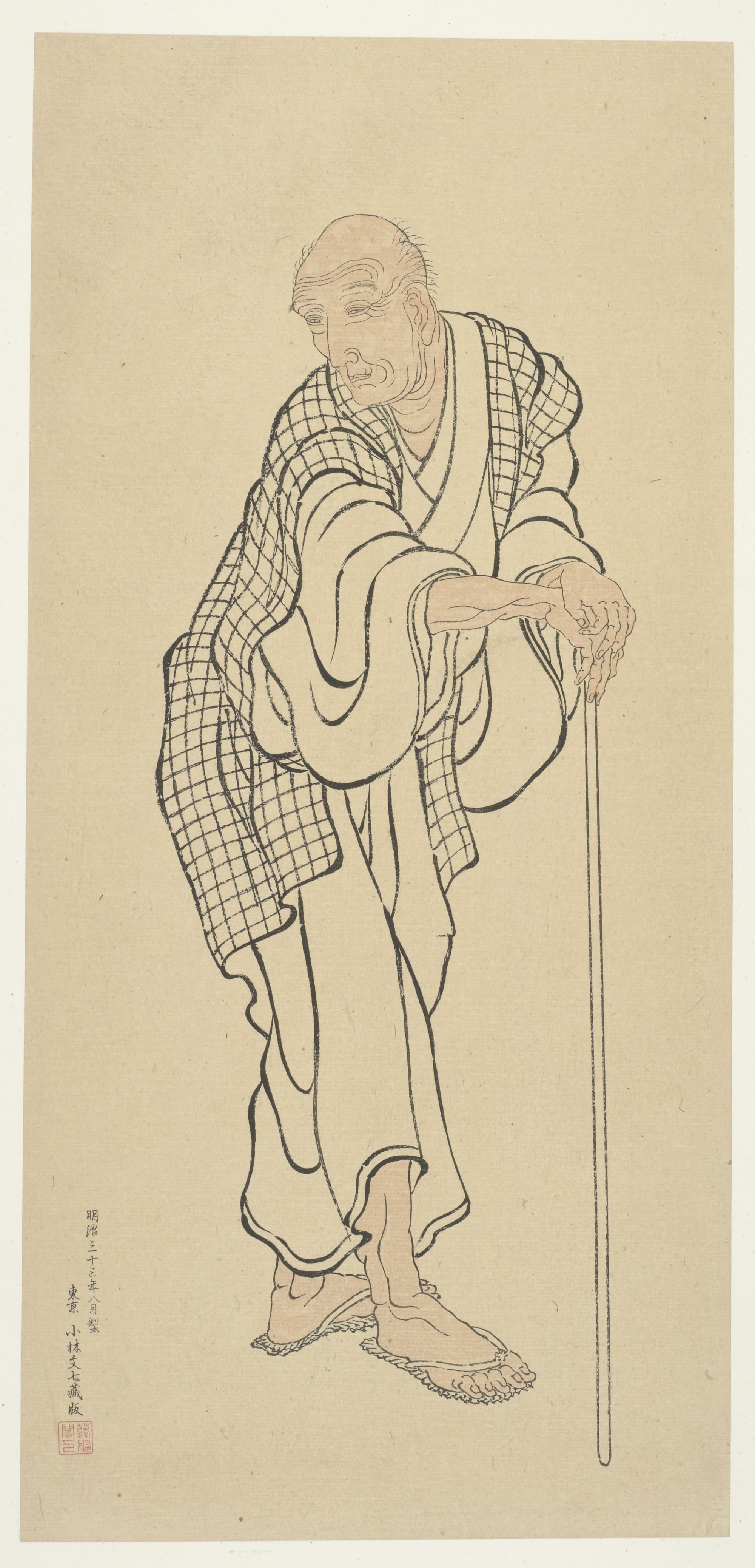
The old man mad about drawing. Hokusai's self-portrait as an old man (c. 1842), walking with a staff and an amused, defiant expression. Public domain.
In Edo Japan, taking a new gō wasn't unusual—artists changed names when they graduated, took over a school, or shifted styles. What Hokusai did with the custom was absurd. Over seventy years of work he used at least thirty different names. Sometimes he sold an old name to a pupil when he needed cash, which was almost always. Sometimes he dropped a name because he was bored with the person who had used it.
His main identities track the phases of his life:
- Shunrō (1779–1794): The dutiful apprentice drawing actors, until Shunshō died and Shunshō's successor, Shunkō, expelled him from the studio—reportedly for secretly studying the rival Kanō school and experimenting with Western copperplate perspective smuggled in through the Dutch trading post at Nagasaki.
- Sōri (1795–1798): A freelance illustrator of luxury poetry calendars (surimono) and landscapes, discovering his own line.
- Hokusai (from 1798): Meaning "North Studio," chosen in honour of Myōken, the Buddhist deity of the North Star. Even after he gave the name "Hokusai" to a pupil too, the public refused to stop calling him by it.
- Taito (1811–1819): The decade of the Hokusai Manga, when he became a national celebrity.
- Iitsu (1820–1834): Literally "One Year Old Again"—taken at age sixty (the completion of a full sixty-year calendar cycle in East Asia, traditionally a rebirth). Every print of Thirty-six Views of Mount Fuji, including The Great Wave, is signed not "Hokusai," but Hokusai aratame Iitsu hitsu ("From the brush of Hokusai, changing his name to Iitsu").
- Gakyō Rōjin Manji (1834–1849): "The Old Man Mad About Art, Manji."
He treated housing the same way he treated names. He moved ninety-three times within Edo and the countryside. When an apartment became too dirty and buried in waste paper and spilled pigment to work in, he found it simpler to pack his brushes and rent another room down the street. Once, according to biographers, he moved into a house, realized it was one he had already lived in and abandoned years earlier, and moved right back out.
II · SHOWMANSHIP AND THE MANGA
A broom dipped in ink and a pair of sparrows with rice on their feet
To survive outside the patronage of a major school, Hokusai turned himself into a public spectacle.
In 1804, at a festival at the Gokoku-ji temple in Edo, he laid out sheets of heavy paper pasted together to cover roughly 200 square metres—larger than a tennis court. Using brooms, buckets of sumi ink, and vats of dye, he ran back and forth across the paper barefoot. From ground level, the crowd saw only giant black smears. Only when the finished sheets were hoisted up onto scaffolding did they realize he had painted a colossal bust of the Buddhist patriarch Daruma, eighteen metres tall.
Word reached the shogun, Tokugawa Ienari, who commanded a private competition between Hokusai (a commoner, which made the invitation nearly unheard of) and a court painter of the classic Tosa school. Hokusai painted a long blue curve down a strip of paper, dipped the feet of a live rooster in red seal ink, and chased the bird down the blue line. He bowed and announced the title: Maple Leaves Floating on the Tatsuta River. He also carved a miniature landscape of two sparrows onto a single grain of rice.
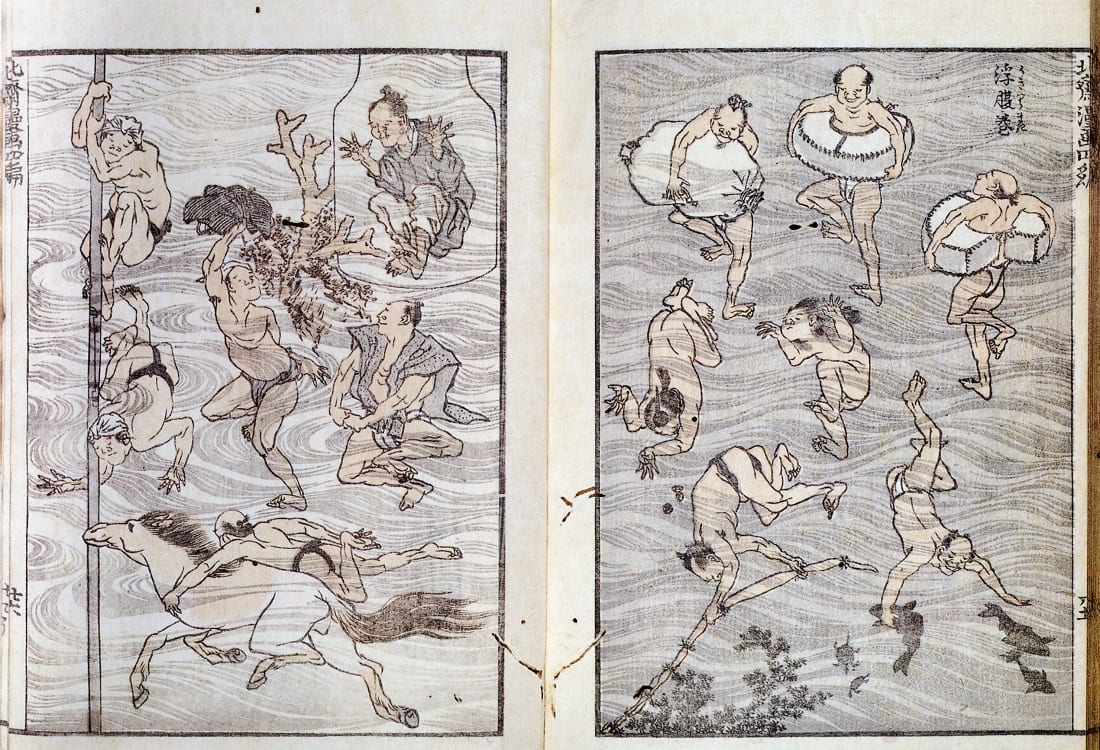
An encyclopaedia of everything that moves. A spread from Volume IV of the Hokusai Manga (1816). Originally compiled as a visual textbook for his students across Japan, it became a runaway bestseller. Public domain.
In 1812, broke and exhausted, Hokusai visited students in Nagoya. To save time teaching them how to draw, he began filling sketchbooks with rapid studies of everything he had ever observed: fat wrestlers, skinny ghosts, wind bending bamboo, frogs, carp, bridges, roof tiles, faces contorted by sneezing, men fighting with sticks.
Published starting in 1814 as the Hokusai Manga ("Hokusai's Random Sketches"), the books eventually ran to fifteen volumes containing roughly 4,000 illustrations. Though not "manga" in the modern sense of sequential comic stories, they popularized the word and made Hokusai famous across Japan.
III · STROKE, LIGHTNING AND RUIN
How the worst years of his life produced the Fuji series
Most artists who reach sixty-seven have either settled into comfortable repetition or died. Between 1827 and 1830, Hokusai's life collapsed entirely.
Around 1827 or 1828, he suffered a stroke that temporarily paralysed part of his body. He claimed to have cured himself using a traditional medicine made from boiled lemon and sake (a recipe he helpfully included in a medical manual). In 1828, his second wife died. He was left alone with his brilliant, unconventional daughter Katsushika Ōi (Eijo)—who had divorced her husband, a clumsy painter, after laughing at his work and moved back in with her father—and a delinquent grandson whose gambling debts wiped out whatever money Hokusai earned.
There was also an incident from earlier in his fifties that had become part of his personal mythology: while walking in the countryside near Nagoya, Hokusai was reportedly struck by lightning (or thrown to the ground by a close strike in a rice paddy) and survived. He believed the lightning had driven the evil spirits out of his body and granted him a second, supernatural lease on life.
By 1829, Hokusai was approaching seventy, hounded by creditors, living in squalor, and mourning his wife. That was the exact moment the publisher Nishimuraya Yohachi (owner of the firm Eijudō) commissioned him to design a series of landscape prints centered on Mount Fuji.
Two new things made the project possible. The first was a boom in domestic travel along the Tōkaidō highway and a religious cult around Mount Fuji (Fujikō), which saw the volcano as the source of immortality—a subject that obsessed the seventy-year-old artist. The second was a chemical import from Europe: Prussian blue (bero-ai, "Berlin blue"), a synthetic iron-cyanide pigment first synthesized in Berlin in 1706 and brought to Nagasaki by Dutch traders and Chinese merchants in the 1820s.
Before bero-ai, Japanese printers achieved blue using natural indigo or dayflower petals, which faded quickly in sunlight and looked flat. Prussian blue was vivid, deep, chemically stable, and capable of rich tonal gradations from pale sky to midnight ocean. Eijudō advertised that the first prints of the new Fuji series would be printed entirely in shades of blue (aizuri-e). Hokusai looked at the new pigment and saw water.
IV · ANATOMY OF A MASTERPIECE
Under the Wave off Kanagawa (c. 1831)
First, the name. We call it The Great Wave off Kanagawa. Hokusai's title, printed in the rectangular cartouche in the upper left corner, is 神奈川沖浪裏 (Kanagawa-oki nami-ura)—literally, "Under the Wave off Kanagawa."
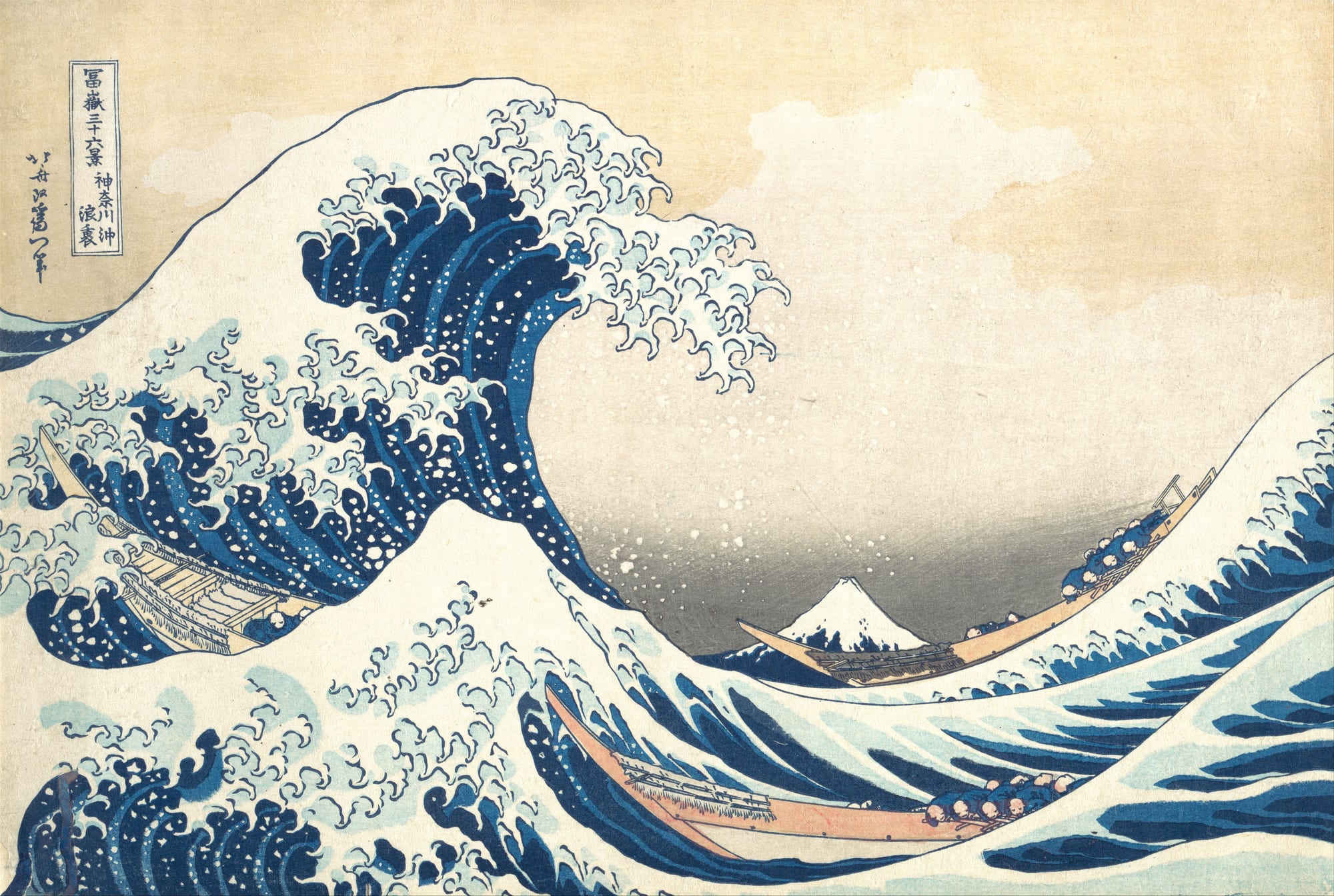
Under the Wave off Kanagawa. An early Edo-period impression (c. 1831) from the series Thirty-six Views of Mount Fuji*, Metropolitan Museum of Art. Notice the pink clouds in the background—a detail that faded or disappeared in many later impressions. Public domain.*
Every part of this 25-by-37-centimetre sheet of mulberry paper is doing more work than appears at first glance:
- It is not a tsunami. Despite being the universal cover image for tsunami textbooks and warning signs, the wave was never meant to depict a seismic sea wave. Oceanographers (including fluid-dynamics studies by researchers at Oxford and Edinburgh) classify it as an okinami ("great off-shore wave") or a rogue wave (freak wave)—an anomalously steep, plunging breaker formed when crossing wave trains constructively interfere under high winds, estimated in the print at 10 to 12 metres (35–40 feet) high.
- The boats are not helpless fishing dinghies going out to sea. There are three boats in the trough, containing twenty-four men (eight rowers per vessel, plus two passengers or relief crew at the bow of each). These are oshiokuri-bune—fast, twelve-metre wooden cargo skiffs used to rush live or fresh-caught fish (like bonito) from the Miura and Bōsō peninsulas across Edo Bay to the shogun's markets in the capital. It is early morning; they have delivered their cargo in Edo and are rowing south, into the wave, heading home. The rowers aren't panicking; they are crouching low over their oars to let the crest pass or punch through the face.
- The double visual pun on Mount Fuji. In the background sits Mount Fuji, snow-capped and tiny, dwarfed by the foreground water through Hokusai's mastery of Western linear perspective. Look at the smaller wave peaking in the immediate foreground at the left: its white foam crest is shaped as an exact replica of Mount Fuji, complete with snow-like spray on its slopes. Meanwhile, the curling dark belly of the giant wave frames the real mountain like a hollow cave, while its white foam tendrils reach down like claws about to snatch the mountain—and the boats—into the sea.
- East-to-West reading. Western viewers scan a picture from left to right, which makes the wave look as if it is rising cleanly from the left side of the frame. Japanese viewers read from right to left. Read the Japanese way, you first meet the boats straining forward from the right, and then your eye crashes directly into a wall of water rising against them. That simple directional difference makes the composition far more violent and claustrophobic to a Japanese eye.
Alongside The Great Wave, the series produced two other quiet titans that form the unofficial triad of the Thirty-six Views: Fine Wind, Clear Morning (Gaifū kaisei, known as Red Fuji), where the late-summer morning sun turns the volcano's flanks brick-red under high mackerel clouds; and Thunderstorm Beneath the Summit (Sanka hakuu), where a jagged orange bolt of lightning splits the dark base of the mountain while the summit sits above the storm in clear air.
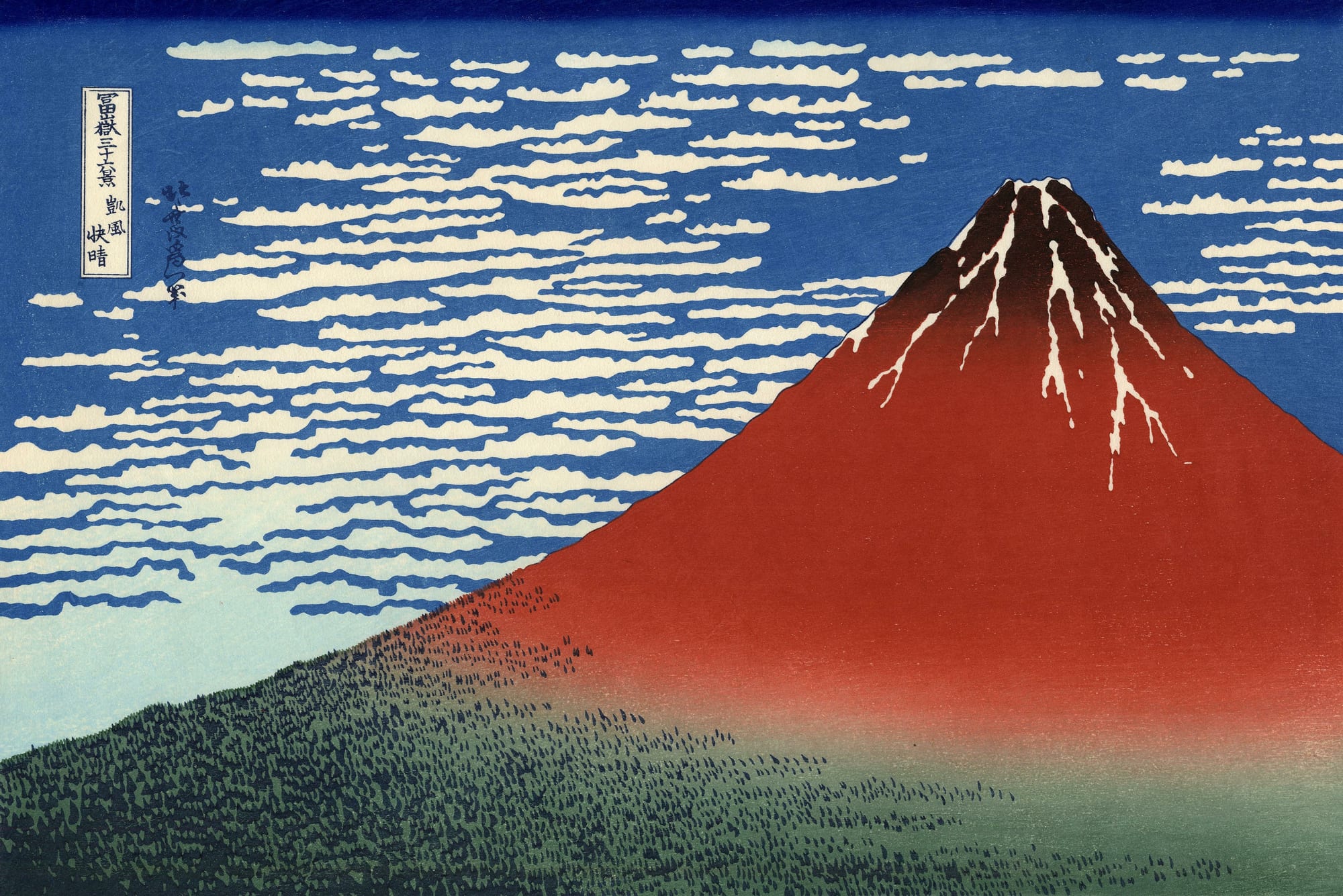
Fine Wind, Clear Morning (Red Fuji). The quiet counterpart to The Great Wave*, using minimal lines, Prussian blue sky, and iron-oxide red to capture the brief moment at dawn in late summer when Mount Fuji glows red. Public domain.*
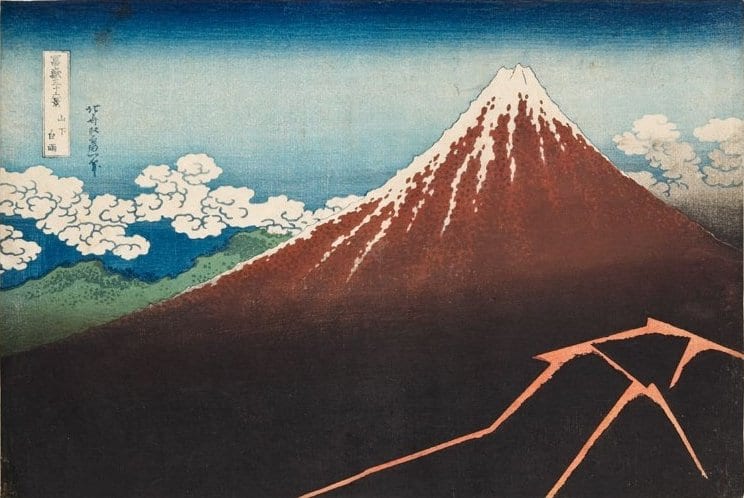
Thunderstorm Beneath the Summit (Black Fuji). The third of the three great Fuji prints, dividing the world between human weather at the foot of the mountain and divine calm at the peak. Honolulu Museum of Art. Public domain.
The series was such a commercial hit that Eijudō didn't stop at thirty-six. They commissioned ten additional designs (known as the ura-Fuji, because they showed the mountain from the "back" or west side rather than from Edo), bringing the total in Thirty-six Views of Mount Fuji to forty-six prints.
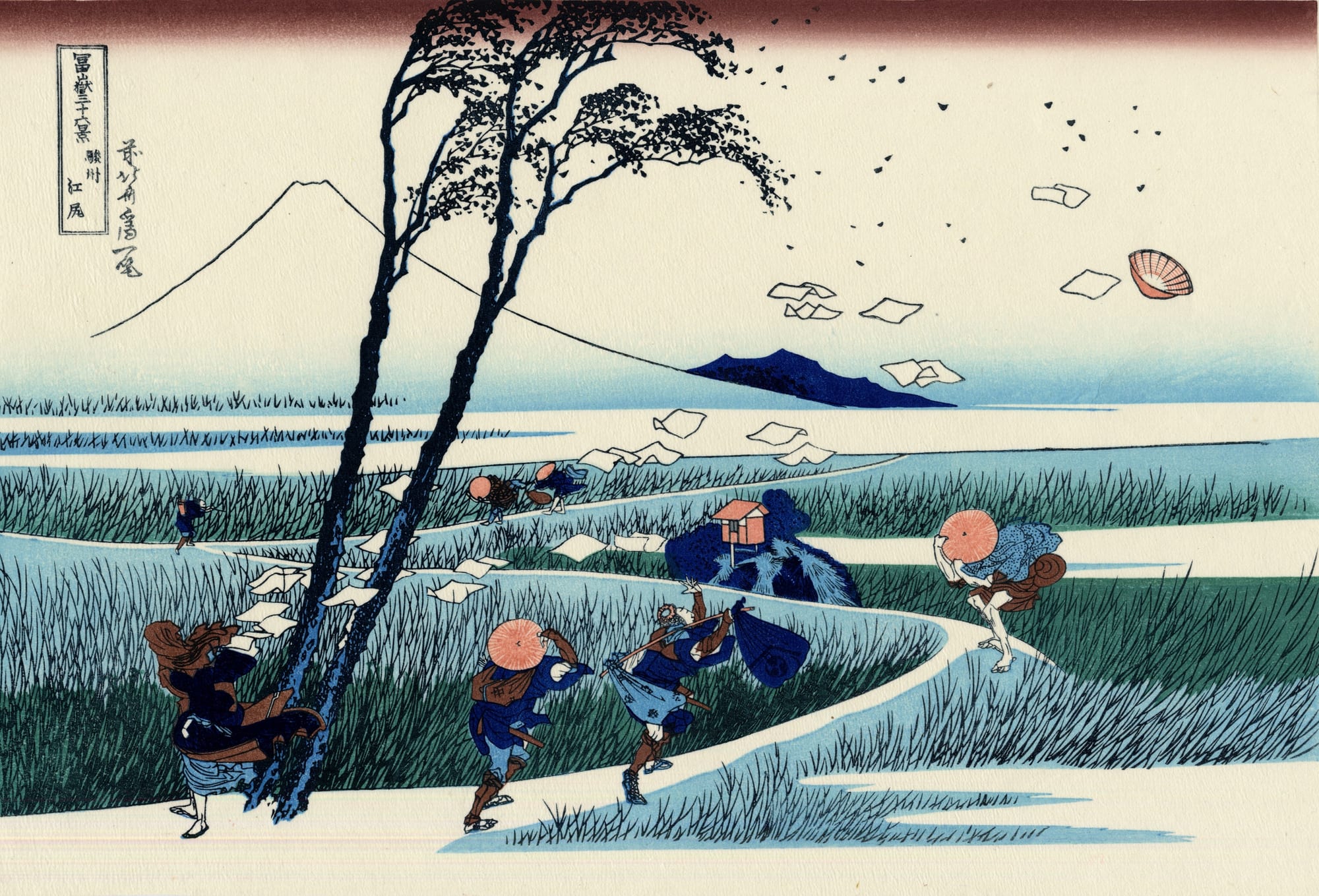
Drawing the invisible. In Ejiri in Suruga Province (c. 1831), also from the Fuji series, Hokusai draws the wind itself through a sudden gust scattering a traveller's tissues into the sky, echoing the curve of the mountain. Public domain.
V · WHY THERE IS NO "ORIGINAL"
The sacrificial drawing, the four-man team, and the worn cherrywood blocks
Here is the question that confuses almost everyone who grows up on Western art history: Where is the original of The Great Wave, and why do museums only ever talk about "prints" or "impressions" of it?
The short answer is that in traditional Japanese nishiki-e ("brocade pictures," multi-colour woodblock printing), the original drawing was destroyed in order to create the printing block.
An ukiyo-e print was not the solo work of one artist. It was an industrial product manufactured by a quartet of specialists (hanmoto shihō):
1. The Publisher (Hanmoto). In this case, Nishimuraya Yohachi. He was the venture capitalist and producer: he funded the project, bought the cherrywood and paper, hired the artist, carvers and printers, navigated government censorship, and owned the physical woodblocks afterward.
2. The Artist (Eshi). Hokusai. He did not carve the blocks and he did not print the sheets. What Hokusai produced was a final, razor-sharp brush drawing in black sumi ink on ultra-thin, translucent mino-gami paper. This master drawing was called the hanshita-e ("under-block picture").
3. The Block Carver (Horishi). This is where the "original" died. The master carver took Hokusai's hanshita-e—the only sheet of paper Hokusai actually touched—and glued it face-down onto a seasoned plank of wild mountain cherrywood (yamazakura) using rice paste. He then rubbed the back of the paper with oil until the paper fibres became transparent, allowing Hokusai's black ink lines to show through in reverse.
Next, the carver took a sharp knife (kōtō) and sliced into the wood along both sides of every single black line Hokusai had drawn, leaving the lines standing up in relief less than a millimetre wide. Everything between the lines was chiselled away. In the process, Hokusai's original drawing was completely shredded and scraped off the wood.
Once that first block—the keyblock (omohan), which prints the dark indigo outlines and the title cartouche—was finished, the carvers pulled roughly a dozen monochrome test sheets (kyōgō-zuri) from it. Those sheets were sent back to Hokusai, who indicated where each colour should go. Those colour-guide sheets were then glued onto additional cherrywood planks and carved away to make the colour blocks (iroita). For The Great Wave, about seven or eight separate blocks (or block faces) were required: dark indigo outline, Prussian blue, medium blue, pale blue, yellow for the boats, grey for the sky, and pale pink for the storm clouds.
4. The Printer (Surishi). Sitting cross-legged on the floor, the printer brushed water-based pigment mixed with rice paste onto a block, laid a dampened sheet of tough kōzo (mulberry bark) paper onto two registration notches carved into the wood (the kentō, which guaranteed sub-millimetre alignment across seven separate pressings), and rubbed the back of the paper with a circular bamboo-sheath pad called a baren. Every shaded gradient in the sky or the boats had to be wiped onto the wet wood by hand before each individual sheet was pressed (bokashi).
So what happened to the original cherrywood blocks?
If the hanshita-e drawing was destroyed in 1831 to make the keyblock, then the closest thing to a "master matrix" was that set of original cherrywood blocks. Where are they?
They do not survive either. Two things happened to them:
- Physical wear during the 1830s. Cherrywood is hard, but pressing damp paper onto sub-millimetre wooden ridges thousands of times with a baren slowly crushes and rounds the wood. Scholars estimate that Eijudō pulled between 5,000 and 8,000 impressions of The Great Wave in the 1830s. Each run of roughly 200 sheets was a pull (atozuri for later pulls).
- Sale, recutting and fire. When Nishimuraya Yohachi's publishing house ran into financial trouble in the late 1830s, the worn blocks were sold off to other publishers, and any surviving woodblocks in Edo's merchant quarters were eventually consumed in the city's frequent fires (or finally the 1923 Great Kantō Earthquake). Every 20th-century and modern woodblock print of The Great Wave (such as those made by the Adachi Institute) is printed from newly recarved blocks traced from surviving 1830s impressions.
How experts read the "scars" to rank surviving prints
Because the cherrywood blocks degraded slowly with every hundred sheets pulled, you can tell almost the exact moment in the 1830s a surviving print of The Great Wave was made by looking at its microscopic flaws under a magnifying glass:
- The Keyblock Outline Color: Unlike European prints, which use black ink for outlines, Hokusai's Great Wave has its outlines printed in dark indigo blue.
- The Cartouche Break: Look at the rectangular box around the title in the top left. In the very earliest impressions (the first few hundred sheets), that thin dark border is unbroken. As the block was pounded thousands of times, the wood along the bottom and right edges of that box cracked and chipped away, leaving gaps in the frame.
- The Missing Clouds: In early impressions (like the British Museum and early Met copies), a subtle pink-grey cumulonimbus cloud bank rises right behind the wave against the yellow-grey sky. Because that colour required an extra pass and delicate hand-wiping, tired printers on later commercial runs skipped the cloud block or inked it so faintly that the sky looks blank.
- The Foam Dots and Boat Rowers: On the earliest pulls, every tiny droplet of spray flying off the wave claws is crisp and hollow, and the faces of the rowers have distinct features. On late pulls (atozuri), the wooden rings had flattened out, turning the droplets into blunt smudges and erasing the rowers' eyes and noses.
Where are the surviving 1830s impressions today, and what were they worth?
When The Great Wave went on sale in Edo bookshops around 1831, a single sheet cost 16 mon—the exact price of a double helping of soba noodles. Because it was cheap street ephemera, people pasted it onto sliding doors, handled it carelessly, or threw it away when it got smoky from cooking fires.
Out of the estimated 5,000 to 8,000 impressions printed from the original blocks in the 1830s, only around 100 to 120 are known to survive worldwide today.
Because light destroys vegetable pigments (especially the yellow of the boats and the pink of the clouds), not a single museum on Earth puts its Great Wave on permanent display. They sit in dark, climate-controlled drawers and come out for a few weeks every several years. The finest surviving early impressions are held by:
- The British Museum (London) — acquired in 2008, widely considered one of the crispest earliest pulls in existence, with vivid pink clouds.
- The Metropolitan Museum of Art (New York) — which holds four separate Edo-period impressions from different stages of block wear (including the H. O. Havemeyer and Henry L. Phillips impressions), allowing scholars to compare early and late pulls side by side.
- The Art Institute of Chicago (three impressions).
- The Library of Congress (Washington, D.C.).
- The Rijksmuseum (Amsterdam) and the Musée Guimet (Paris) — Claude Monet owned a personal impression that still hangs at his house in Giverny, and Claude Debussy kept one on his study wall and put it on the cover of the 1905 first edition score of La Mer.
- The Tokyo National Museum, the Sumida Hokusai Museum (Tokyo), and the Japan Ukiyo-e Museum (Matsumoto).
And the price of that 16-mon bowl of noodles today? In March 2023, an early impression of The Great Wave sold at Christie's in New York for $2.76 million USD—setting the world auction record for any Hokusai print.
VI · THE OLD MAN MAD ABOUT ART
One Hundred Views, a house fire at seventy-nine, and the final decade
In 1834, at age seventy-four, Hokusai followed his colour series with a three-volume black-and-grey woodblock book called One Hundred Views of Mount Fuji (Fugaku hyakkei).
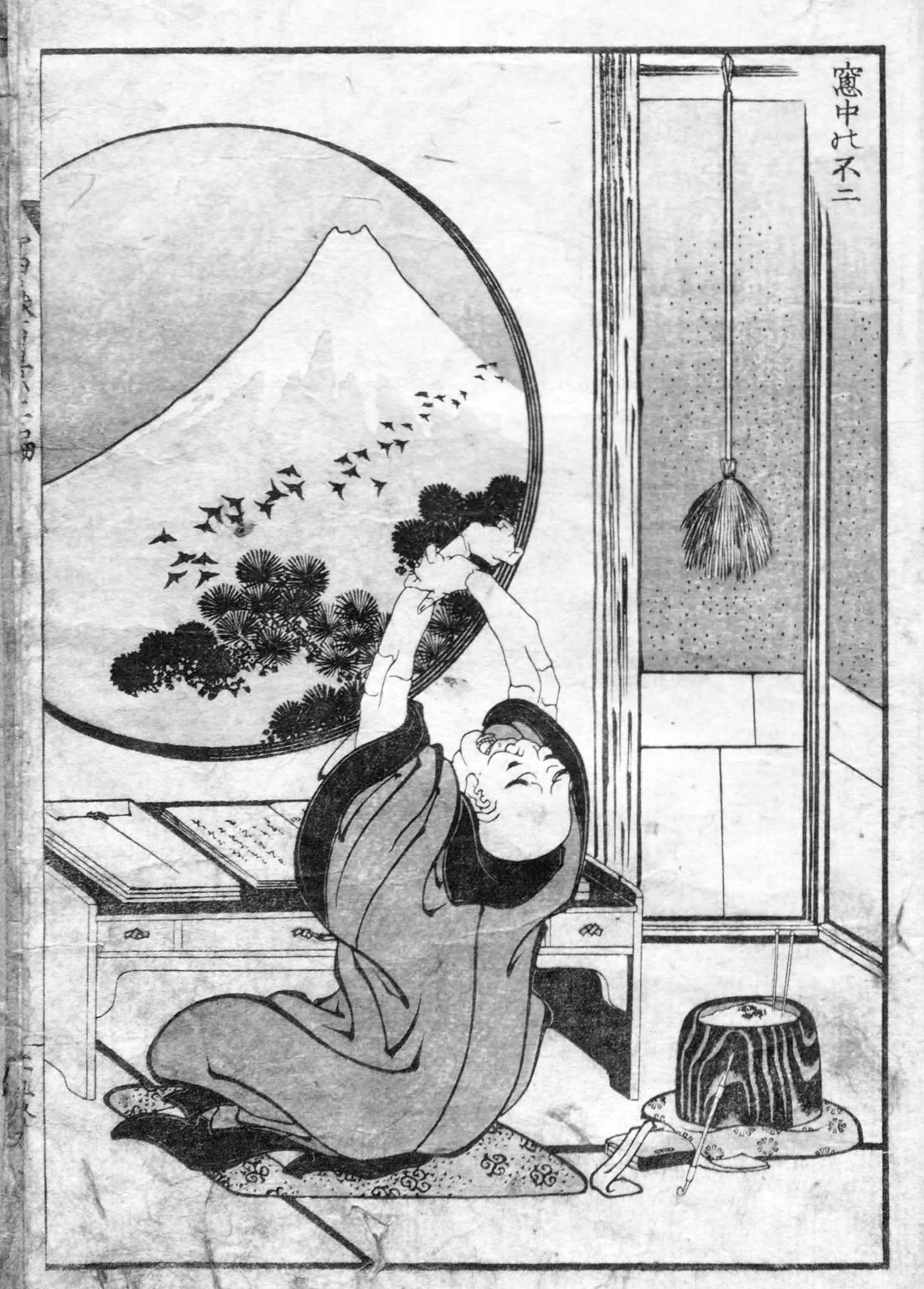
Fuji through a studio window. A page from One Hundred Views of Mount Fuji (1834–35), signed as Gakyō Rōjin Manji ("The Old Man Mad About Art"). Public domain.
In the postscript to the first volume, Hokusai wrote the most famous artistic manifesto in Japanese history:
"From the age of six, I had a mania for drawing the shapes of things. By the time I was fifty I had published an infinity of designs, but all I have produced before the age of seventy is not worth taking into account. At seventy-three I have learned a little about the real structure of nature, of animals, plants, trees, birds, fishes and insects. Consequently when I am eighty, I shall have made still more progress. At ninety I shall penetrate the mystery of things; at a hundred I shall certainly have reached a marvellous stage; and when I am a hundred and ten, everything I do—be it a dot or a line—will be alive."
Five years later, in 1839, when he was seventy-nine, his house burned down. Unlike the ninety-two times he had walked out of a house on purpose, this time he barely escaped with his life, holding only a single bundle of brushes. Decades of saved sketchbooks, reference manuals and unpublished drawings went up in smoke.
His response was to walk four days across the mountains into Nagano province (over 200 kilometres from Edo) in his eighties to visit a wealthy brewer and patron named Takai Kozan in the town of Obuse. There, in his mid-eighties, Hokusai painted huge, swirling dragon and phoenix panels on the ceilings of festival floats (yatai) and temples—actual brush paintings on wood that do survive in the original in Obuse today.
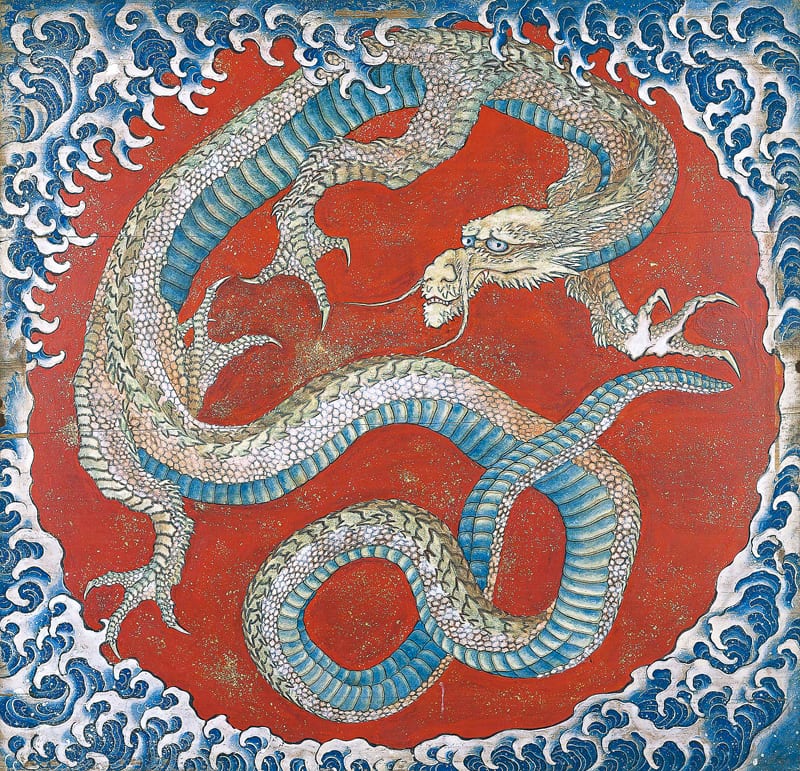
An actual original brush painting. The dragon painted by Hokusai in 1844, at age eighty-four, for the ceiling of the Higashimachi festival float in Obuse, Nagano. Unlike his woodblock prints, his late nikuhitsu-ga ("flesh-brush paintings") on silk, paper and wood are unique originals. Hokusaikan Museum, Obuse. Public domain.
In the last ten years of his life, as demand for his prints cooled in favour of his younger rival Utagawa Hiroshige, Hokusai returned to nikuhitsu-ga—unique, hand-painted scrolls on silk and paper. Living with his daughter Ōi (herself a master of dramatic light and shadow who almost certainly helped paint parts of his late works), he produced haunting images right up to the spring of 1849, including The Dragon of Smoke Escaping from Mount Fuji.
In the spring of 1849, at eighty-eight (eighty-nine by traditional Japanese counting), he fell ill for the last time. From his futon he reportedly sighed to those around him:
"If only Heaven will give me just another ten years... Integrity demands at least five more years, then I could become a real painter."
He composed a death poem—"Though as a ghost, I shall lightly tread the summer fields"—and died on 10 May 1849 (the 18th day of the 4th month of Kaei 2). He was buried at the Seikyō-ji temple in Taitō, Tokyo, leaving behind an estimated 30,000 drawings, book illustrations, paintings and print designs.
Four years after his death, Commodore Matthew Perry's Black Ships sailed into Edo Bay—right past Kanagawa, across the exact stretch of water where Hokusai had drawn his three cargo boats rowing into the wave—and forced Japan open to the West. Within a decade, cheap sheets of Hokusai's prints were circulating through the studios of Paris, teaching Manet, Degas, Monet, Cassatt and Van Gogh how to flatten space, crop a frame, and look at water.
TIMELINE
The life and arc of Katsushika Hokusai at a glance
| Year | Age | Event |
|---|---|---|
| 1760 | 0 | Born in Honjo Warigesui, Katsushika district, Edo (Tokyo), given childhood name Tokitarō |
| 1774 | 14 | Apprenticed to a woodblock carver (horishi), learning the physical limits of cherrywood |
| 1778–79 | 18–19 | Enters the studio of Katsukawa Shunshō; receives his first art name, Shunrō |
| c. 1794 | 34 | Expelled from the Katsukawa school after studying rival Kanō and Western perspective techniques |
| 1795–98 | 35–38 | Works as Sōri, producing luxury surimono prints; adopts the name Hokusai ("North Studio") in 1798 |
| 1804 | 44 | Paints a 200-square-metre portrait of Daruma with a broom at Gokoku-ji temple; performs before Shogun Tokugawa Ienari |
| 1814 | 54 | Publishes Volume I of the Hokusai Manga under the name Taito; eventually reaches 15 volumes and ~4,000 sketches |
| 1820 | 60 | Completes his 60-year zodiac cycle and takes the name Iitsu ("One Year Old Again") |
| 1827–28 | 67–68 | Suffers a stroke and recovers; his second wife dies; daughter Katsushika Ōi moves in to care for and work with him |
| c. 1830–33 | 70–73 | Publishes Thirty-six Views of Mount Fuji (46 designs total) using imported Prussian blue (bero-ai) |
| c. 1831 | 71 | Under the Wave off Kanagawa (The Great Wave) published; original hanshita-e drawing destroyed during block carving; ~5,000–8,000 sheets printed |
| 1834 | 74 | Publishes One Hundred Views of Mount Fuji under the name Gakyō Rōjin Manji ("The Old Man Mad About Art") with his famous postscript on reaching 110 |
| 1839 | 79 | Studio burns down, destroying decades of saved notebooks and drawings |
| 1842–48 | 82–88 | Makes four long journeys to Obuse (Nagano), painting giant festival float ceilings and temple dragons |
| 1849 | 88 | Dies in Edo on 10 May after asking Heaven for five more years to "become a real painter" |
| 2023 | — | An early 1830s impression of The Great Wave sells at Christie's New York for $2.76 million |
Sources
1. Clark, Timothy (2017), Hokusai: Beyond the Great Wave, Thames & Hudson / British Museum Press.
2. "The Great Wave off Kanagawa" and "Thirty-six Views of Mount Fuji," Wikipedia (block wear analysis, surviving impressions, and oshiokuri-bune boats). en.wikipedia.org
3. "Katsushika Hokusai," Wikipedia. en.wikipedia.org
4. Smith, Henry D. II (1988), Hokusai: One Hundred Views of Mt. Fuji, George Braziller (translation of the 1834 postscript and analysis of Prussian blue in the 1830s).
5. Dudley, J. M., Sarano, V., & Dias, F. (2013) and McAllister, M. L. et al. (2019), Oxford & Edinburgh fluid mechanics studies reproducing the Draupner rogue wave and Hokusai's Great Wave in wave tanks.
6. Christie's New York (2023), "Katsushika Hokusai (1760–1849), Kanagawa oki nami ura (Under the Well of the Great Wave off Kanagawa)," Lot 171, Japanese and Korean Art auction, 21 March 2023.
Images: all woodblock prints and paintings are public domain historical works via Wikimedia Commons (Metropolitan Museum of Art, Honolulu Museum of Art, and Hokusaikan Museum Obuse collections).