Patrick Jane and the Strategic Power of Having No Ego
Most fictional detectives need you to know they are the smartest person in the room while they beat you. Patrick Jane does the exact opposite: he weaponizes public failure, cowardice, and looking like a fool to make killers lower their guard—without ever losing an ounce of self-esteem.
Most fictional detectives need you to know they are the smartest person in the room while they are beating you. Patrick Jane does the exact opposite: he weaponizes public failure, cowardice, and looking like a fool to make killers lower their guard—without ever losing an ounce of self-esteem.
Patrick Jane is often grouped with the classic television archetype of the "arrogant genius detective"—the Sherlock Holmes, Gregory House, or Hercule Poirot figure who walks into a room, dazzles everyone with a deduction, and feeds on the applause of being the smartest person in the building.
Look closely at how Jane actually operates in the early seasons of The Mentalist, however, and you find the exact opposite. Patrick Jane has no performative ego. He does not care if suspects, judges, police chiefs, or his own teammates think he is an idiot, a coward, a charlatan, or a failure—as long as their belief makes them take the exact step he needs them to take.

I · THE ORIGIN OF DETACHMENT
The tragedy that burned his ego to ash
To understand why being wrong in public has zero effect on Jane’s self-esteem, you have to look at his origin story (revealed in the Pilot and explored in flashbacks like Season 2, Episode 10, "Thrown Fire"). Before the series begins, Jane did have an ego. He was a celebrity television "psychic" who went on national talk shows and bragged that his powers were helping the police profile and catch Red John, calling the serial killer an ugly, tormented little man.
He went home that night to find Red John’s note on his bedroom door—and his wife and daughter murdered inside.


That single night permanently severed the link between public validation and self-worth for Patrick Jane. The last time he cared about looking brilliant in front of an audience, it cost him everything he loved. From that point forward, social status became weightless to him. When a man has already paid the ultimate price for vanity, being laughed at in a police precinct or reprimanded by a district attorney does not even register as a scratch.
II · WEAPONIZING FAILURE
The mechanics of strategic buffoonery: why "being wrong" works
Most intelligent people suffer from a fatal tactical weakness: they need you to know they are smart while they are beating you. When they make a mistake, they get defensive; when they know the answer, they want credit right away.
Jane understands a core principle from his carnival days: an opponent who respects your intelligence keeps their guard up, while an opponent who thinks you are a clown gets sloppy.
By intentionally making wrong accusations or botching his "mentalist tricks" in front of a room full of suspects, Jane achieves three tactical objectives at once:
- Adrenaline Crash in the Real Killer: When a murderer sees the famous CBI consultant walk into the room, their heart rate spikes and they carefully monitor every word they say. When Jane confidently accuses the wrong person—or pulls a parlor trick that fails—the real killer experiences a sudden wave of relief. In that moment of relaxation, they stop policing their body language and believe they have won.
- Provoking Action: A suspect who thinks the police are closing in on them will destroy evidence or lawyer up. A suspect who thinks the lead investigator is an incompetent buffoon chasing a dead end will go back to the crime scene, move the murder weapon, or try to silence an accomplice.
- Bypassing Legal Roadblocks: Jane rarely has hard forensic proof. If he simply tells Lisbon who did it, the suspect hires a defense attorney and walks free. Jane has to make the suspect incriminate themselves in the act, and the easiest way to make a proud person overextend is to play the fool in front of them.


III · IN PRACTICE
Episode case studies (Seasons 1–3, spoiler-free)
Across the early seasons, Jane repeatedly sacrifices his dignity, his reputation, and his "genius" image to bait a trap:
The Botched Seance / Reading — Season 1, Episode 7 ("Seeing Red")
When dealing with Kristina Frye, a practicing "psychic" who refuses to break character, any normal skeptic with an ego would spend the whole episode trying to prove he is smarter than her in front of the team. Instead, Jane sets up a fake spiritual channeling session with the suspects. He plays into the exact theatrical nonsense he publicly despises, letting the family think he is either losing his grip or putting on a cheap sideshow—solely to trick the killer into sneaking into a hidden room where the cameras are waiting.
Playing the Gullible Con Victim — Season 1, Episode 19 ("A Dozen Red Roses")
Investigating a murder among Hollywood producers and arrogant actors, Jane doesn't walk in acting like a sharp investigator. He acts like a starstruck, slightly dim hanger-on who is easily manipulated by wealth and status. He lets the suspects talk down to him and treat him like the help, feeding their vanity until their arrogance causes them to walk straight into a staged confrontation on a movie set.
The High-Stakes "Loser" — Season 1, Episode 6 ("Red Handed")
At a casino resort on the California-Nevada border, Jane sits down at the card tables. While he uses his card-counting and reading skills to win huge sums when he wants to, he is just as happy to look like a reckless, distracted gambler throwing chips away or making foolish bets when it serves to draw out the casino management and the killer. He never cares how the pit bosses view his skill; the cards are just props to force human reactions.


Taking the Fall in Court — Season 2, Episode 3 ("Red Badge") & Season 3, Episode 7 ("Red Hot")
Whenever Jane is put on the witness stand or hauled in front of Internal Affairs or a judge, he never defends his professional competence. In fact, he frequently admits on the record to being a former con artist, a liar, or someone who "just guesses things and got it wrong this time." If torpedoing his own credibility in front of a courtroom ruins a killer's alibi or forces a recess that buys Lisbon two hours, he humiliates himself on the stand with a cheerful smile.
The "Failed" Accusation Parlor Trick — Season 2, Episode 2 ("The Scarlet Letter") & Season 3, Episode 9 ("Red Moon")
A recurring Jane signature: he gathers three or four suspects, announces with grand dramatic flair that he is going to identify the killer using a psychological test, and then points at someone who is obviously innocent—or has the test fail completely. The suspects laugh at him, Lisbon looks mortified on his behalf, and the local police mock the CBI. Jane simply shrugs, mutters "Well, win some, lose some," and walks out. Because the real killer now believes Jane is completely off their scent (or thinks an innocent person is about to be framed), they make the fatal move later that night where Rigsby and Cho are waiting in the dark.
IV · ZERO MALE BRAVADO
The cowardice act
Another area where Jane has zero ego is physical dominance. In almost every crime drama, the male lead has to prove he is tough—trading threats with gangsters, standing his ground in bar fights, or staring down gunmen.
Jane does the exact opposite. The moment a suspect raises a fist or pulls a weapon, Jane immediately hides behind Lisbon, puts his hands up, whines, or runs out of the room (e.g., Season 1, Episode 22, "Blood Brothers" or Season 2, Episode 14, "Blood In, Blood Out"). When he gets punched in the face—which happens at least once or twice a season—he doesn't try to fight back to save his pride; he rubs his jaw, complains that it hurt, and goes right back to analyzing why the person hit him.
By refusing to play the alpha-male game, he strips aggressive people of their primary weapon. You cannot intimidate a man who openly admits he is terrified of getting hit and has no masculine pride to bruise.


V · INTERNAL VS. EXTERNAL
Self-esteem vs. ego: why it never hurts him
There is a fundamental psychological distinction between self-esteem (knowing your own competence internally) and ego (needing other people to reflect that competence back to you).
| Dimension | The Ego-Driven Genius (Sherlock / House) | The Ego-Free Tactician (Patrick Jane) |
|---|---|---|
| Primary Objective | Solve the puzzle and force the room to acknowledge their brilliance | Close the trap on the target at any social cost |
| Reaction to Public Error | Defensiveness, anger, or an urgent need to prove they were actually right | A cheerful shrug—because the error was either the bait itself or free data |
| Status in the Room | Demands to be the dominant voice and alpha intellect | Happily plays the fool, the coward, or the annoying sidekick |
| Emotional Vulnerability | Can be baited by insults to their intelligence | Unbaitable on intelligence—only vulnerable through his past grief |
Because Jane already knows how the trick works inside his own head, he doesn't need the audience to clap during the setup. In fact, a stage magician needs the audience to believe he has fumbled the sleight of hand right before the prestige.
People who care about looking right, smart, or respectable are bound by the rules of social approval—which means they can be steered by flattery or stopped by embarrassment. Jane is committed solely to the mission. Because he is willing to look completely wrong on purpose, he holds total leverage over people who are desperate to look right.
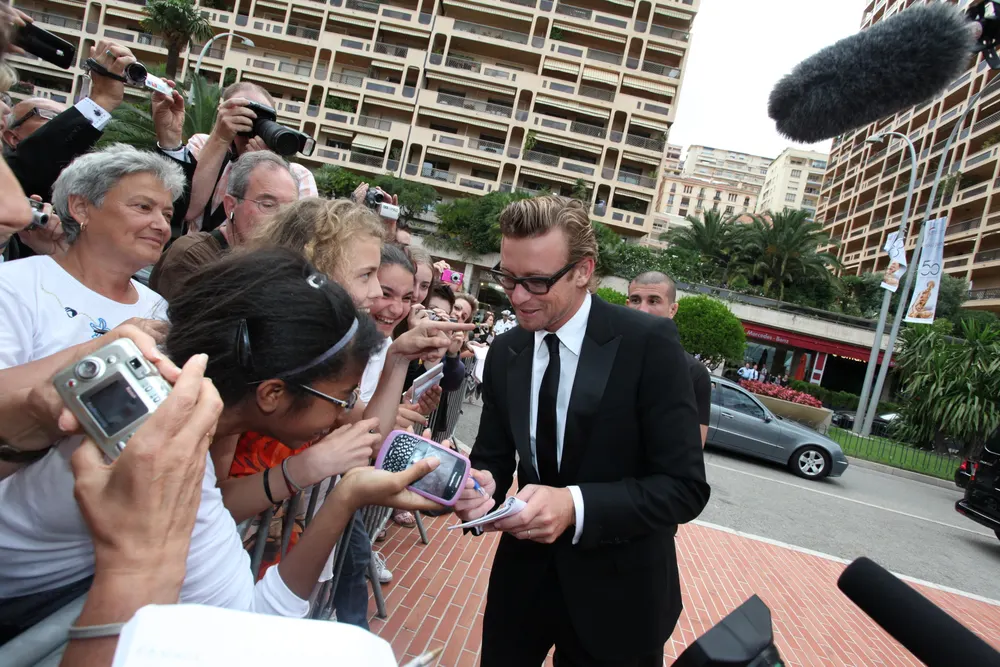
Cover photo: Simon Baker at the 2010 Monte-Carlo Television Festival. Photo: Eric Mathon / Festival de Télévision de Monte-Carlo, CC BY-SA 3.0, via Wikimedia Commons.
