Before They Were Dinosaurs: How Humanity Discovered the Deep Past
For thousands of years people dug up giant bones and had no idea what they were. Giants, dragons, the casualties of Noah's flood, "jokes of nature." This is the history of the history of dinosaurs: how we went from total, documented ignorance to a science that is still rewriting itself every year.
Giants, dragons, Noah's raven and a bone labelled "Scrotum Humanum": the long and often absurd road from finding giant bones to understanding them, and why dinosaur science still hasn't settled down.
The word dinosaur is only 184 years old. The animals are about 230 million years old. Human beings have been picking up their bones for at least two thousand years, and probably much longer. For nearly all of that time, nobody knew what they were looking at.
This post isn't really about dinosaurs. It's about how people came to know about them: what they believed before, the first times someone wrote down a wrong answer (which is how you can actually date ignorance), and how a pile of misread bones became one of the most self-correcting sciences we have. Every generation in this story was sure it finally had the picture. Every one of them was partly wrong, and that's the interesting part.
I · BEFORE THE IDEA EXISTED
Giants, dragons and the bones of the flood
You can't discover something you have no category for. Before about 1800, Europeans lacked the two ideas you need to make sense of a dinosaur bone: that the Earth is extremely old, and that whole kinds of animals can vanish for good. Without those, a giant bone could only be one of three things: something that still lived somewhere, something from Scripture, or something that was never alive at all.
Dragons in China. The record most often cited as the oldest written mention of what may have been dinosaur bones comes from China. In the 4th century CE the historian Chang Qu wrote of "dragon bones" dug up at Wucheng in Sichuan, a region full of Jurassic rock. Whether those particular bones were dinosaurs is impossible to prove. What is certain is that longgu, "dragon bone," was sold for centuries as medicine, ground into powder for all kinds of ailments. Most of it was actually fossil mammal bone and teeth. The ignorance here turned out to be useful: in 1935 the palaeontologist Ralph von Koenigswald found a giant ape tooth in a Hong Kong apothecary's drawer and named Gigantopithecus from it, a species that science first met at a pharmacy counter.
Griffins and giants in the Mediterranean. The Greeks and Romans found huge Pleistocene mammal bones and read them as the remains of heroes and Titans. Suetonius says the emperor Augustus decorated his villa on Capri with "bones of giants." In 2000 the historian Adrienne Mayor put forward a famous and appealing theory that the griffin, a beaked, four-legged guardian of gold, was inspired by Protoceratops skulls that Scythian gold miners came across in Central Asia. The idea went into museums and documentaries. Then in 2024 the palaeontologists Mark Witton and Richard Hing tested it properly. They found that Protoceratops fossils turn up hundreds of kilometres from the ancient gold sites, that griffin art is plainly built from big cats and birds, and that griffins appear in Egypt and the Middle East long before any trade route could have brought fossil stories west. A myth about a myth had been corrected, which suits a story that is mostly about corrections.
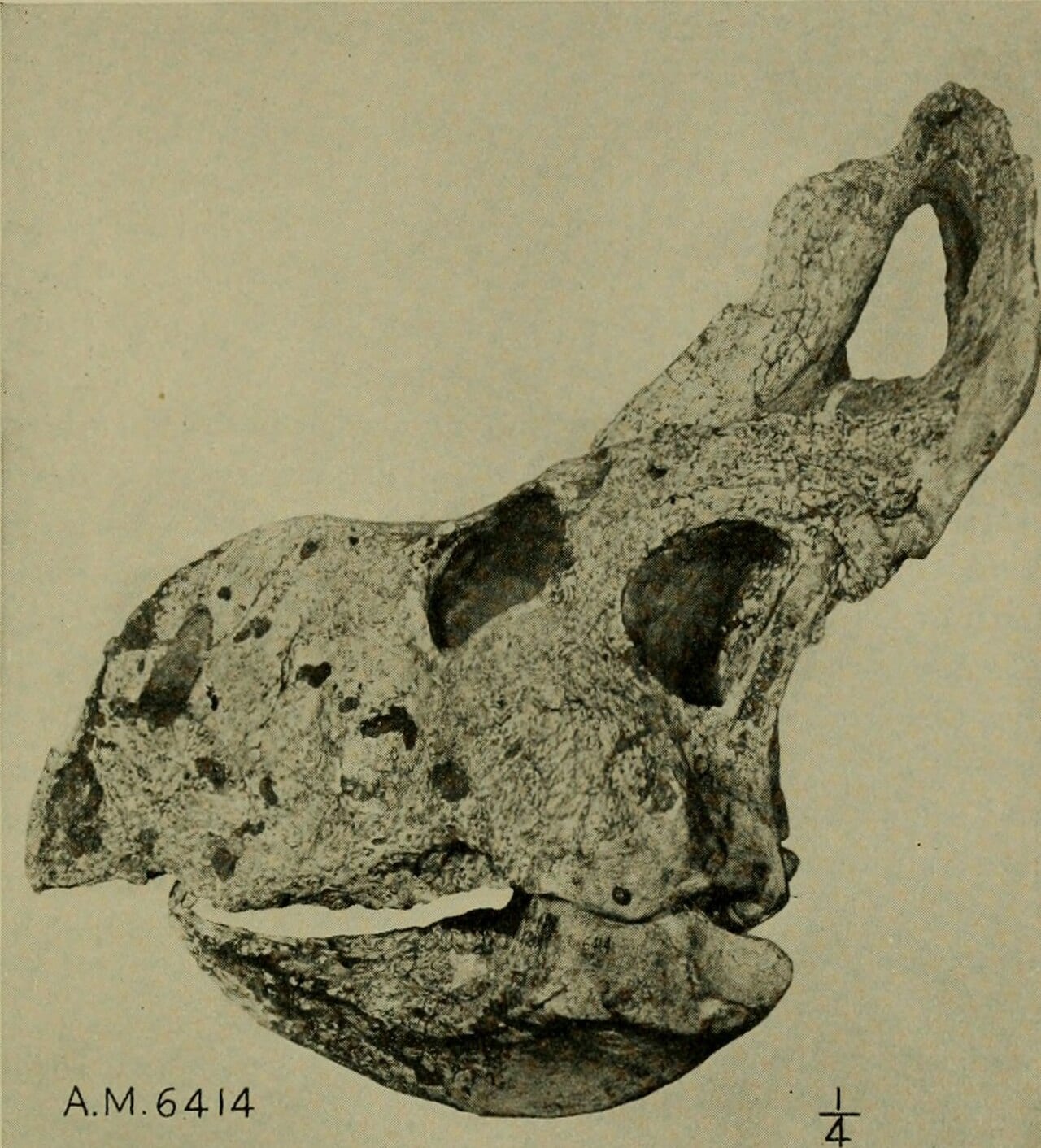
The skull behind a modern myth. A Protoceratops andrewsi skull (AMNH 6414) from Mongolia. Its beak and frill made it a neat candidate for the origin of the griffin until 2024, when the idea was examined closely and didn't hold up. Public domain.
Jokes of nature. Medieval and Renaissance scholars mostly didn't read fossils as remains at all. They thought they were lapides figurati, "figured stones" that grew inside the rock through a vis plastica, a shaping force in the Earth that copied living forms the way frost draws ferns on a window. A shell in a mountain was a lusus naturae, a joke of nature. In England, ammonites sold as "snakestones," with carved heads added, credited to St Hilda turning snakes to stone. Fossil fish teeth were sold as "toadstones," said to come from the heads of toads and to work against poison.
The first crack came in 1667. The Danish anatomist Nicolas Steno dissected a shark's head and saw that the glossopetrae, the "tongue stones" found in Maltese rock, were simply shark teeth. Two years later his Prodromus laid down the basic rule of geology: rock layers form in order, the lowest ones first. Around the same time, Robert Hooke, in Micrographia (1665), argued that fossils were once alive and, more daringly, that some might belong to species that no longer existed. Hardly anyone accepted that last point for another century.
II · REGISTERED IGNORANCE
The first written mistakes
The best evidence of ignorance is a confident description that turned out wrong. Dinosaur science starts with several.
1677, Robert Plot. The first keeper of Oxford's Ashmolean Museum, Plot published The Natural History of Oxford-shire with an engraving of a heavy, rounded bone end from a quarry at Cornwell. He identified it, correctly, as the lower end of a thigh bone. It was far too big for any living animal he knew. He thought about whether it could be from an elephant the Romans brought to Britain, rejected that, and decided it must be the bone of a giant human, the kind of being Scripture mentions. The bone is lost, but from the engraving it is now almost universally taken to be the end of a femur from Megalosaurus or a close relative. It is the first dinosaur bone known to have been illustrated in print, and it was described as a person.
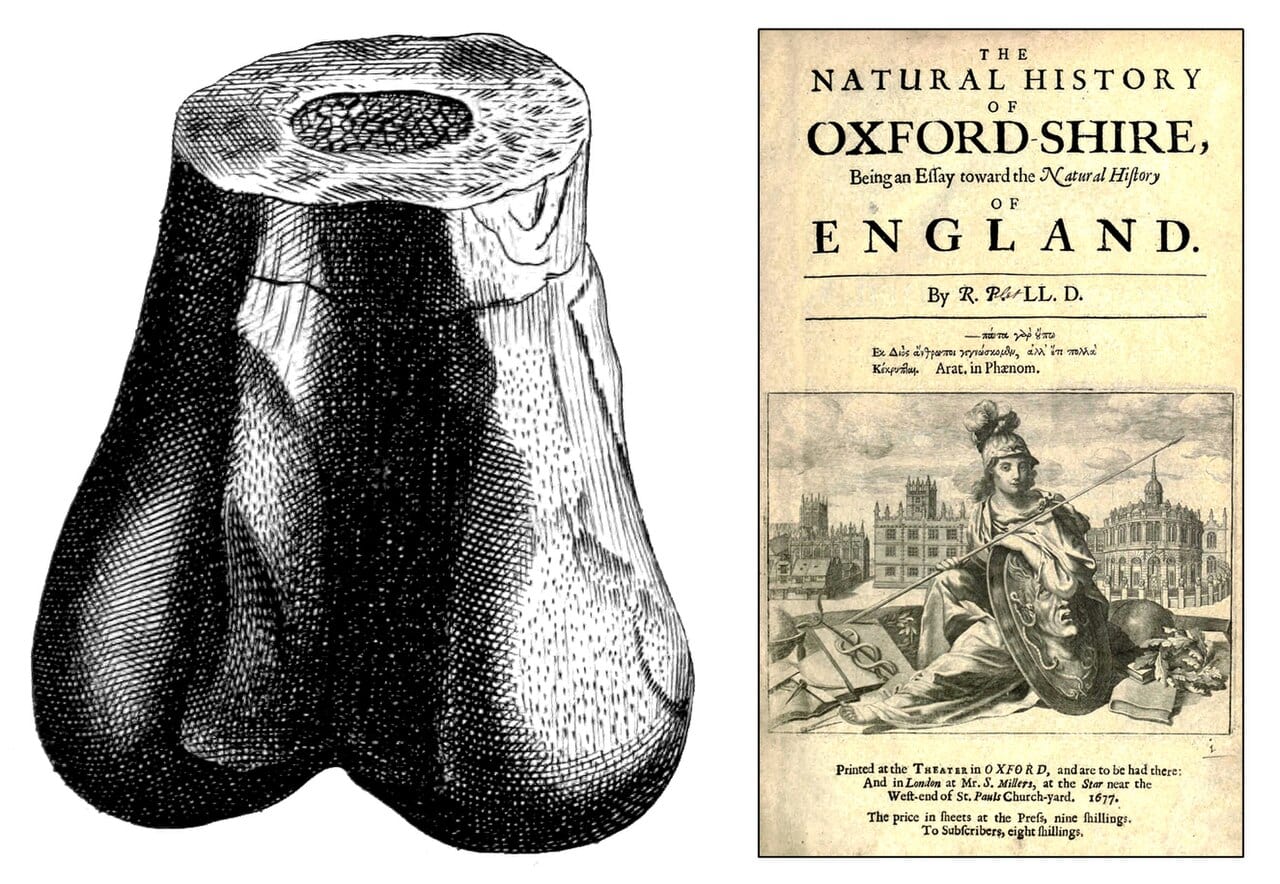
The first dinosaur ever printed. The title page of Robert Plot's Natural History of Oxford-shire (1677) and his engraving of the bone, almost certainly the end of a Megalosaurus femur. Plot took it for the thigh of a giant man. Public domain.
1699, Edward Lhuyd. Plot's successor at the Ashmolean published a catalogue of British fossils with a drawing of a strange, spoon-like tooth. It is now thought to be one of the first published teeth of a sauropod-like dinosaur. Lhuyd gave it a Latin name and moved on. It was a figured stone, one more curiosity on the list.
1763, Richard Brookes. Reprinting Plot's engraving, Brookes labelled it "Scrotum Humanum," because the worn condyles really do look like a pair of giant human testicles. Whether he meant it as a formal name has been argued about ever since (in the 1970s there was even a half-serious claim that, under the rules of zoological naming, it should take priority over Megalosaurus). But as a record of where Western knowledge stood in the 1760s, it's hard to improve on: a dinosaur bone, in print, filed under human anatomy.
1802, Pliny Moody. A farm boy in South Hadley, Massachusetts, turned up a slab with three-toed footprints. Locals called them the tracks of "Noah's raven." In the 1830s the geologist Edward Hitchcock collected thousands of these Connecticut Valley tracks and carefully argued they were made by giant extinct birds. He was wrong about what made them and, in a deeper sense, right: they were theropod dinosaur tracks, and theropods are the group birds came from. It took science about 150 years to see what Hitchcock had half-seen.
III · THE IDEA OF EXTINCTION
Deep time, and a lizard in a Dutch mine
Two ideas had to arrive before anyone could know dinosaurs.
The first was deep time. James Hutton's Theory of the Earth (1788) argued that the slow processes we see today (erosion, sedimentation, uplift) working over unimaginable periods could explain the rocks, leaving "no vestige of a beginning, no prospect of an end." The Earth stopped being six thousand years old in the minds of geologists, even if not in the pulpit.
The second was extinction. That was harder to accept than it sounds now. To many minds, a creation where species could disappear was a flawed creation. Thomas Jefferson, who described the giant ground sloth Megalonyx in 1797, privately hoped Lewis and Clark might come across living mastodons in the American West. The man who settled the matter was the French anatomist Georges Cuvier. In 1796 he showed that mammoths and mastodons were anatomically distinct from living elephants, not just big ones, and that animals that size could hardly be hiding unnoticed. Species did go extinct. Cuvier went further: the record showed a series of vanished worlds, each ended by a catastrophe.
Then came the reptile. In the 1770s quarrymen in the chalk mines of St Pietersberg near Maastricht dug out an enormous toothed jaw. When the French took the city in 1795 the skull was carried off as war booty to Paris. Cuvier identified it as a giant extinct marine lizard, and in 1822 it was named Mosasaurus. It isn't a dinosaur, but it set the template: an age when huge reptiles ruled.
IV · THE ENGLISH DECADES
A fossil-seller, a clergyman and a country doctor
The decisive decades took place in England, and in a striking way the main actors were outsiders.
Mary Anning (1799–1847) was a poor, working-class, Dissenting woman in Lyme Regis who sold fossils from the crumbling Jurassic cliffs to survive. Around 1811–12 she and her brother Joseph found the first ichthyosaur skeleton to be properly recognised. In 1823 she found the first complete plesiosaur, so odd (Cuvier at first suspected a forgery) that it nearly ruined her reputation before it made it. In 1828 she found Britain's first pterosaur. The gentlemen of the Geological Society, which wouldn't admit women, built careers on specimens she found, prepared and frequently interpreted. She died before most of them gave her credit.
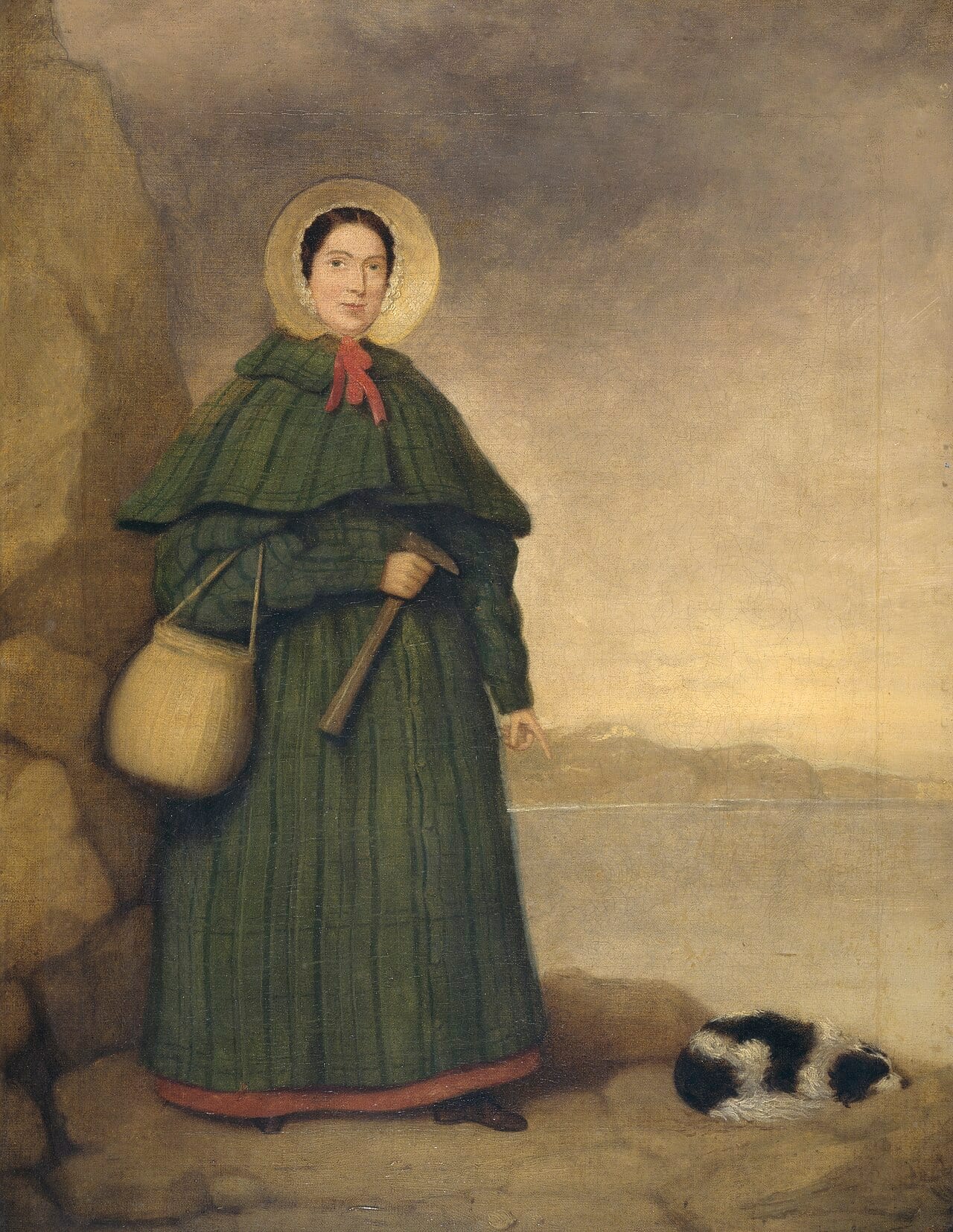
Mary Anning. The Lyme Regis collector, painted before 1842 with her dog Tray and the Golden Cap cliffs behind her. Her ichthyosaurs and plesiosaurs gave the first scientific shape to a lost "age of reptiles." Public domain.
Her animals gave the public its first look at that world. In 1830 the geologist Henry De la Beche painted Duria Antiquior, "A More Ancient Dorset": ichthyosaurs and plesiosaurs biting each other underwater while pterosaurs flap overhead. It is generally regarded as the first scene of prehistoric life drawn from fossil evidence, the start of what we now call palaeoart. It was printed and sold to raise money for Anning.
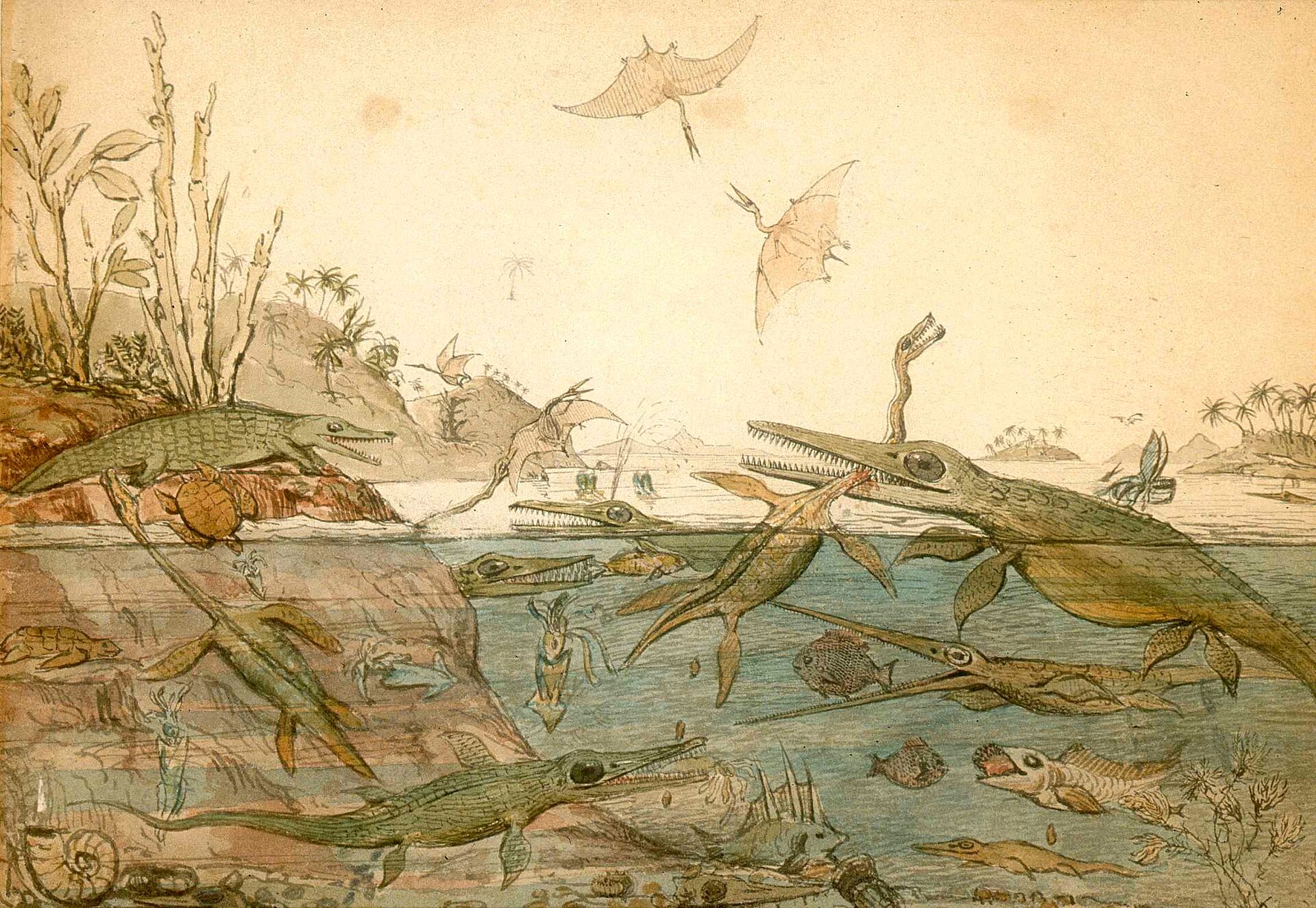
The first picture of the deep past. Henry De la Beche's Duria Antiquior (1830), built on Anning's finds. Everything is fighting, a convention that has lasted in palaeoart ever since. Public domain.
1824: the first dinosaur gets a name. On 20 February 1824, the eccentric Oxford clergyman-geologist William Buckland (who claimed to have tasted his way through the animal kingdom) described to the Geological Society a set of bones from the Stonesfield slate quarries: a lower jaw with blade-like serrated teeth, vertebrae, and parts of the hip and limbs. He called the animal Megalosaurus, "great lizard," and pictured it as a gigantic carnivorous lizard some 12 metres long. The jaw was drawn by Mary Morland, who later married him. Megalosaurus was the first non-avian dinosaur ever validly named. It was also, quite possibly, the same kind of animal whose femur Plot had drawn 147 years earlier.
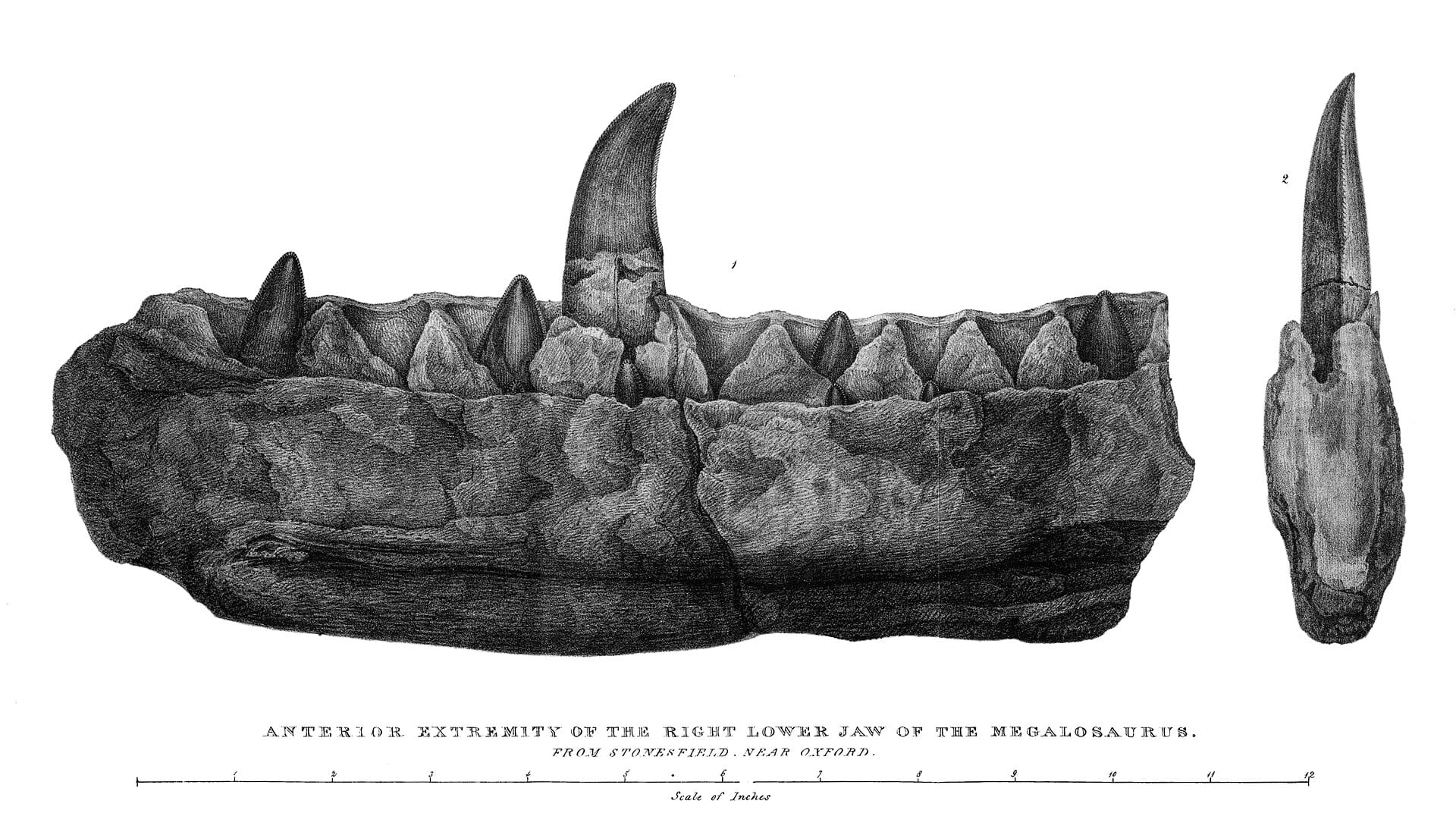
The jaw that started it. Plate from Buckland's 1824 "Notice on the Megalosaurus or great Fossil Lizard of Stonesfield," from drawings by Mary Morland. The socketed, serrated teeth were unlike any living reptile's. Public domain.
1825: the iguana tooth. Gideon Mantell, a doctor in Lewes, Sussex, had been collecting large, worn, ridged teeth from the Tilgate Forest (according to a much-loved but uncertain story, his wife Mary Ann found the first ones). The experts were dismissive: Cuvier at first suggested rhinoceros, others fish. Mantell noticed they looked like the teeth of a living iguana, only twenty times larger, and in 1825 named the animal Iguanodon. Scaling up from an iguana, he estimated that it might have been 30 metres long or more. It was a herbivore, a second dinosaur, and the beginning of a sequence of reconstructions that were each wrong in a different way.
In 1834 quarrymen near Maidstone blasted a slab with a partial skeleton in it. With it Mantell drew his famous sketch: a huge quadruped lizard with a spike on its nose. The spike was actually a thumb, though nobody would learn that for another 44 years.
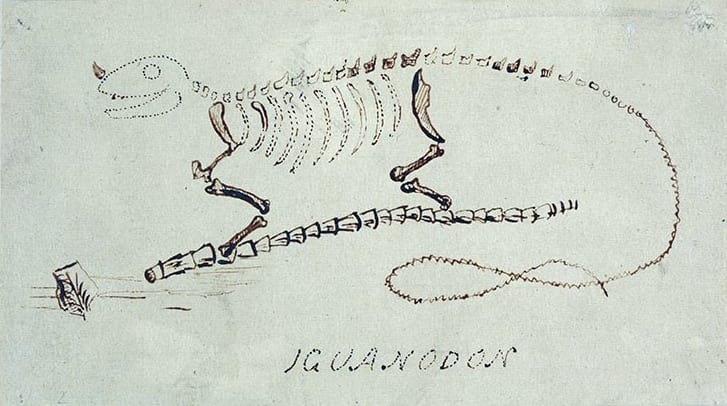
A lizard with a horn on its nose. Gideon Mantell's sketch of Iguanodon from the Maidstone slab, after 1834. The "horn" was a thumb spike, and the animal stood nothing like this. Public domain.
V · A NAME AND A SPECTACLE
Owen's "terrible lizards" and a dinner inside a dinosaur
By 1841 there were three of these animals: Megalosaurus, Iguanodon and Mantell's armoured Hylaeosaurus (1833). The brilliant, ambitious and widely disliked anatomist Richard Owen looked at them and saw shared features that set them apart from any lizard: five fused vertebrae over the hips, and legs held under the body like a mammal's, not sprawled out to the sides. In a report to the British Association delivered in 1841 and published in 1842, he named a new group: Dinosauria, from Greek deinos ("terrible," in the sense of fearfully great) and sauros ("lizard").
Owen had an agenda. He was fighting the radical evolutionists of his time, followers of Lamarck, who argued that life climbed steadily from simple to complex. His dinosaurs were something like pachyderms among reptiles: upright, warm-bodied in his telling, more advanced than any reptile alive today. If ancient reptiles were better than modern ones, life hadn't progressed in a straight line. So the founding definition of the dinosaur was in part a polemic.
Then the public got its look. When the Crystal Palace was moved to Sydenham in south London, the sculptor Benjamin Waterhouse Hawkins, advised by Owen, built the first life-sized models of extinct animals anywhere. On New Year's Eve 1853, Owen and around twenty guests ate dinner inside the mould of the Iguanodon. The park opened in 1854 to enormous crowds, and the British public had "dinomania" more than a century before Jurassic Park.
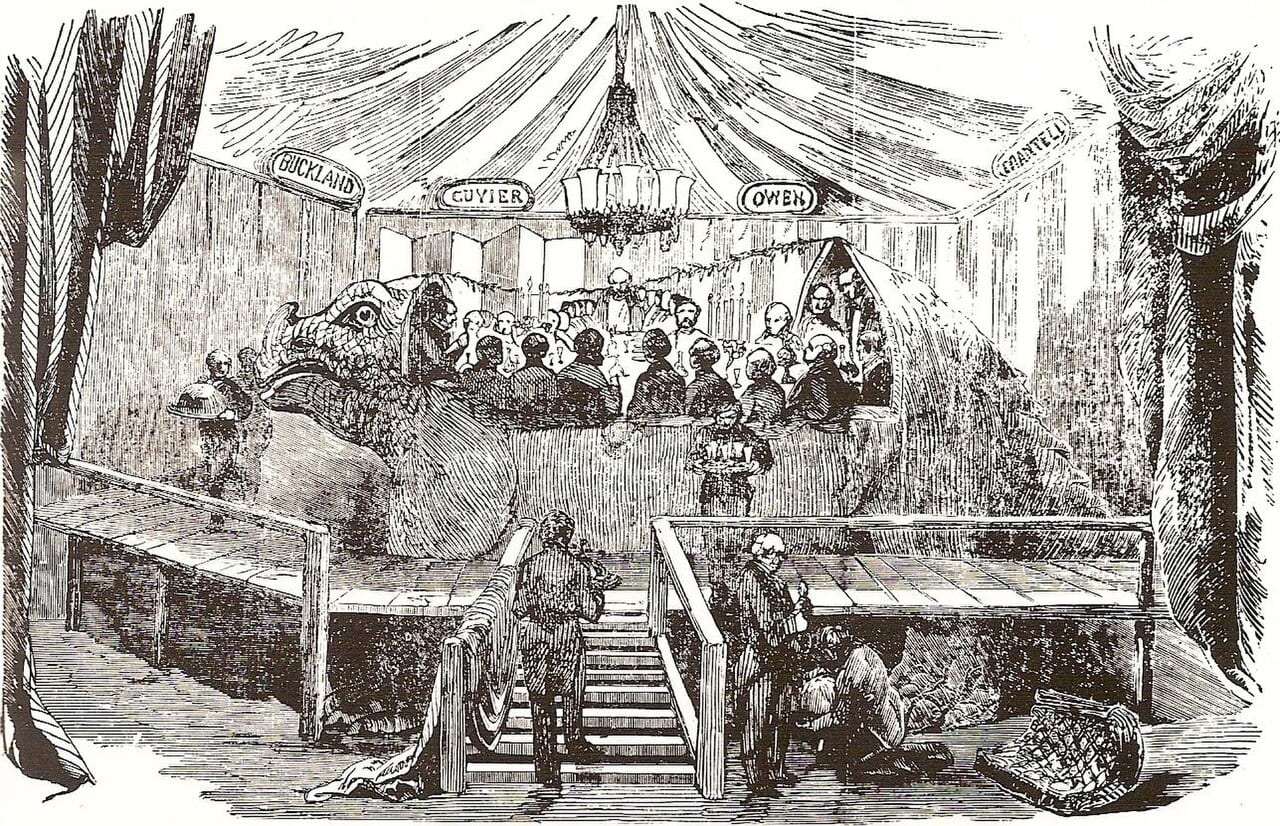
Dining in a dinosaur. The New Year's Eve banquet of 1853 held in the mould of Hawkins's Iguanodon at Sydenham, from the Illustrated London News*. Public domain.*
The sculptures are still there, Grade I listed and lovingly restored. They show the Owen-era Iguanodon as a rhinoceros-like four-footed beast with the thumb spike still on its nose: a scientific mistake set in concrete and kept as a monument to how knowledge works.
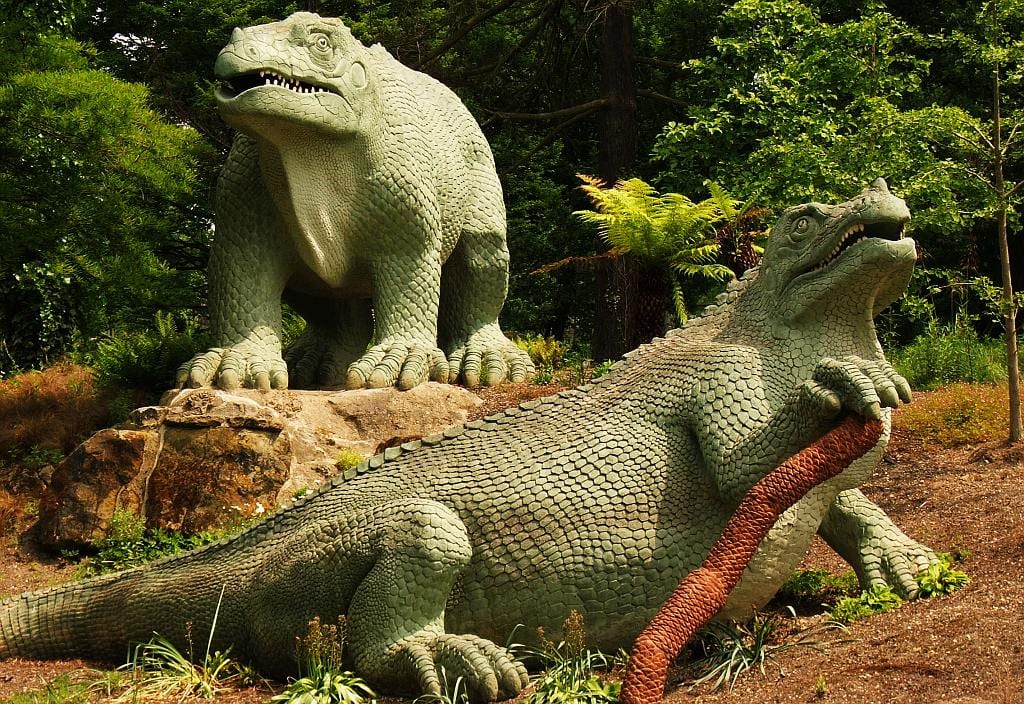
An error, in concrete, kept on purpose. Hawkins's Iguanodons in Crystal Palace Park, London. Photo: Jes from Melbourne, CC BY-SA 2.0, via Wikimedia Commons.
VI · THE AMERICAN RUSH
Standing up, and the Bone Wars
The next jump came from New Jersey. In 1858 a marl pit at Haddonfield produced the most complete dinosaur skeleton then known. Joseph Leidy of Philadelphia named it Hadrosaurus foulkii and drew the inference the English had missed: the hind limbs were far longer than the forelimbs, so the animal must have stood on two legs, at least some of the time. In 1868 Hawkins mounted it at the Academy of Natural Sciences, the first dinosaur skeleton ever displayed standing up, propped on its tail like a kangaroo. Attendance at the Academy shot up. A planned Hawkins dinosaur hall in Central Park ended in 1871, when men linked to the Tammany boss William "Boss" Tweed smashed his workshop and reportedly threw the pieces into a lake.
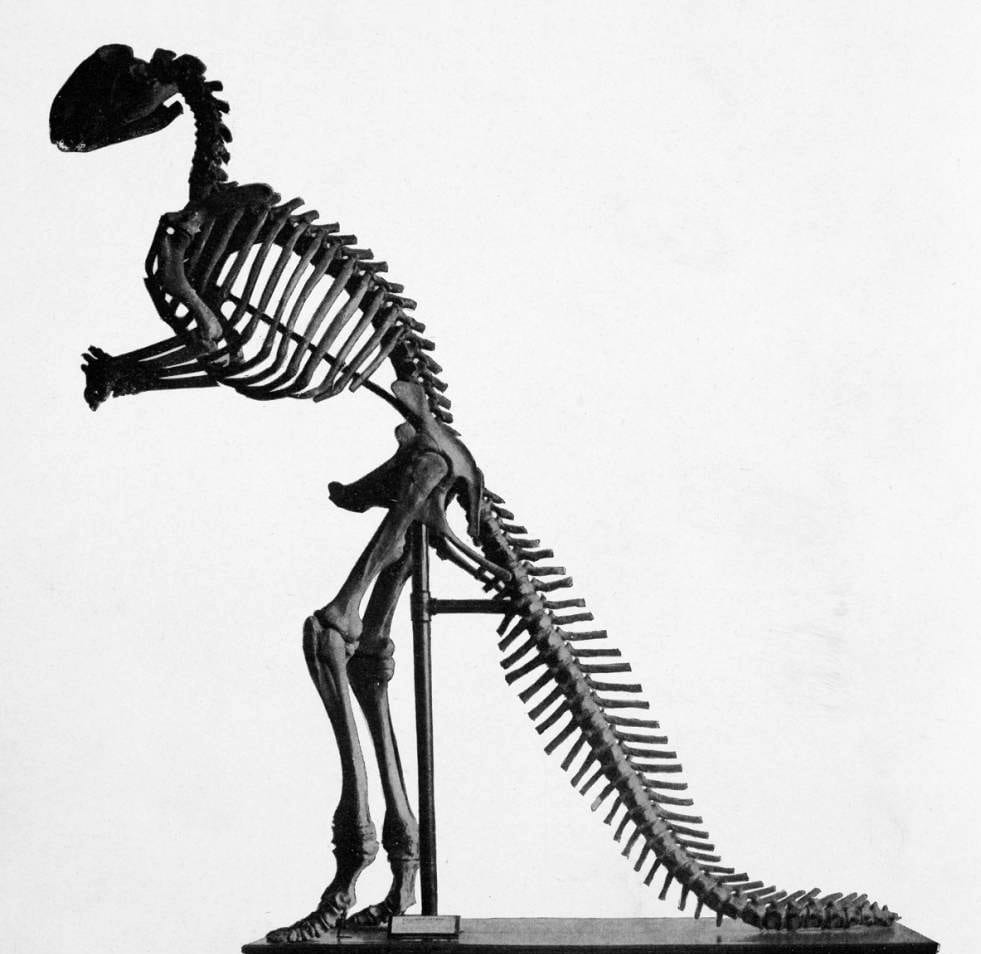
The first standing dinosaur. The Hadrosaurus foulkii mount by Benjamin Waterhouse Hawkins and Joseph Leidy, 1868: two-legged, kangaroo-style, with a head Hawkins invented. Public domain.
After that came the most notorious feud in the history of science. Edward Drinker Cope and Othniel Charles Marsh, once friendly, became bitter enemies. One well-known spark: in 1868 Cope reconstructed the long-necked marine reptile Elasmosaurus with its head on the end of its tail, and Marsh (according to the usual telling) made sure everyone knew it. From the 1870s to the 1890s their teams worked the fossil beds of Colorado, Wyoming and Montana. They bribed, spied, poached each other's diggers, and allegedly smashed fossils so the other side couldn't have them. In 1890 the fight ended up on the front page of the New York Herald.
It was ugly and staggeringly productive. Between them they named roughly 140 new species, among them Stegosaurus, Allosaurus, Triceratops, Diplodocus, Camarasaurus and Brontosaurus. The rush also produced its own errors. Marsh's Brontosaurus was mounted with the wrong skull and was later merged into Apatosaurus. It was then revived as a valid genus in 2015, a neat example of a name dying and coming back on new evidence.
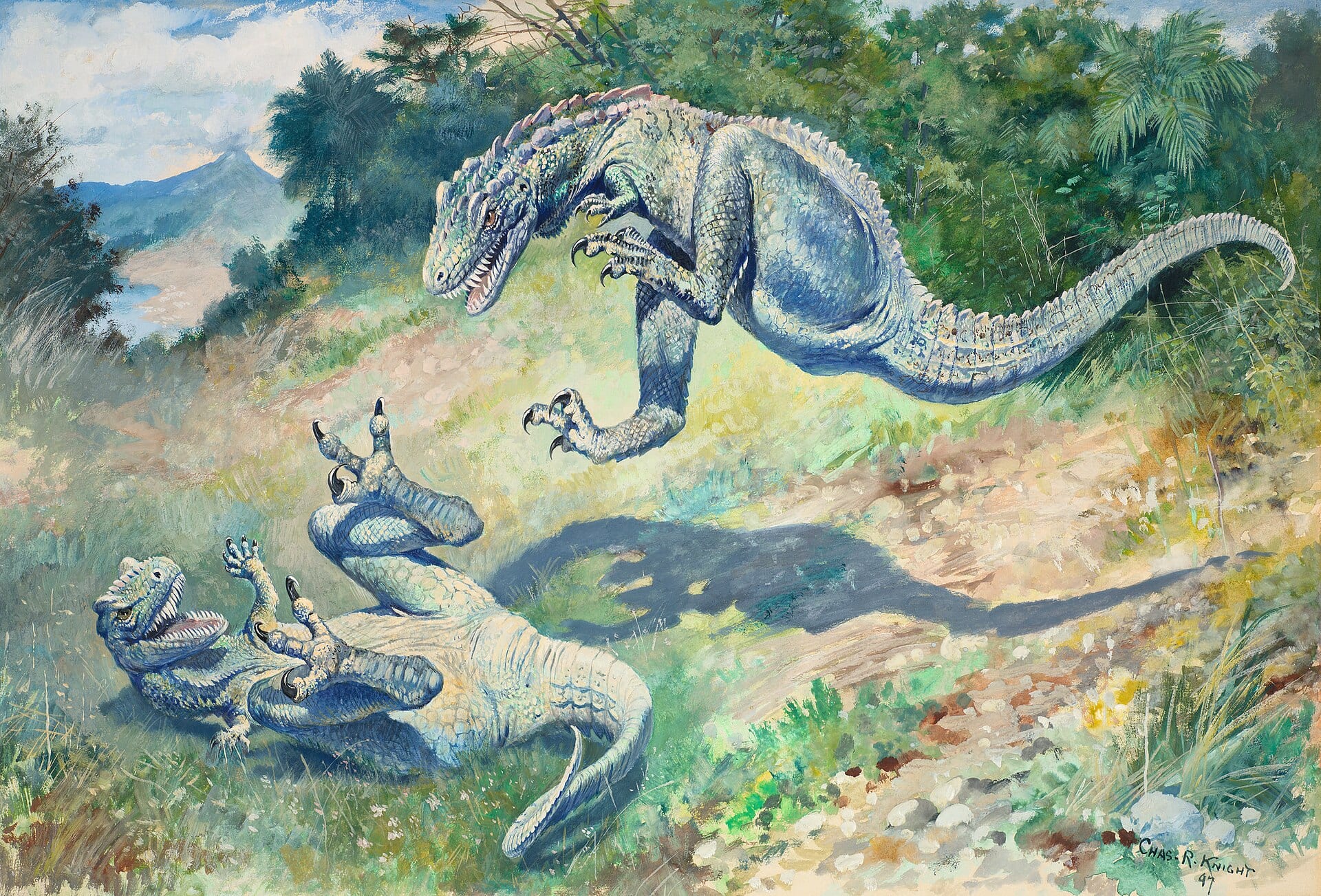
In 1897 the young artist Charles R. Knight, working with Cope, painted Leaping Laelaps: two predatory dinosaurs fighting, one of them in mid-air. It's one of the few images before the 1960s that shows dinosaurs as fast, agile, alive. For the next sixty years the field mostly went the other way.
A vision ahead of its time. Charles R. Knight's Leaping Laelaps (1897), now Dryptosaurus*. Seventy years before the "Dinosaur Renaissance," it showed theropods as agile animals. Public domain.*
VII · THE MISSING LINK THAT WAS HIDING IN PLAIN SIGHT
Darwin, Archaeopteryx, and a debate that took a century
Darwin's On the Origin of Species came out in 1859 with almost no fossil support. Two years later, quarrymen at Solnhofen in Bavaria found Archaeopteryx: an animal with the feathers and wings of a bird, plus teeth, clawed fingers and a long bony tail. A more complete specimen, found in the 1870s, ended up in Berlin.
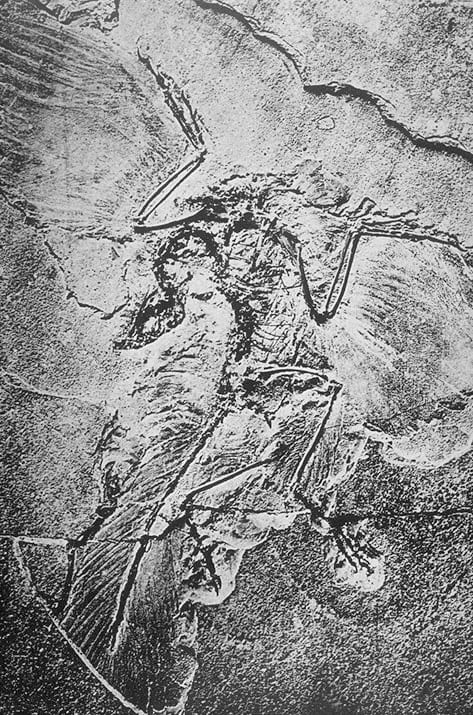
Half bird, half reptile. The Berlin specimen of Archaeopteryx in an 1880 photograph, before preparation removed the leg feathers that can still be seen here. Public domain.
Thomas Henry Huxley, "Darwin's bulldog," compared it with the small Bavarian dinosaur Compsognathus and in 1868 argued that birds were descended from dinosaurs. He was right. But in 1926 the Danish artist Gerhard Heilmann wrote The Origin of Birds, an influential book that agreed the resemblance was striking and then rejected the link: dinosaurs seemed to have no collarbones, and birds have a wishbone made from fused collarbones. Since a lost structure couldn't come back, dinosaurs couldn't be the ancestors of birds. Theropod collarbones and wishbones were in fact sitting in collections, misidentified. The bird-dinosaur question went quiet for almost fifty years because of a gap in evidence that wasn't really a gap.
VIII · THE GLOBAL AGE AND THE GREAT SLUMP
Expeditions, eggs, and the idea of the loser
The early 20th century made dinosaur hunting global and monumental.
- 1878, Bernissart, Belgium. Coal miners came across dozens of complete Iguanodon skeletons more than 300 metres underground. Louis Dollo mounted them in a chapel in Brussels, the only room tall enough, and the "nose horn" went back onto the thumb where it belonged.
- 1902–1905, Montana. Barnum Brown dug the first partial Tyrannosaurus rex out of the Hell Creek Formation. Henry Fairfield Osborn named it in 1905, and a celebrity was born.
- 1909–1913, Tendaguru, German East Africa (now Tanzania). A German expedition sent around 250 tonnes of bones to Berlin, including the giant Brachiosaurus now called Giraffatitan.
- 1915, Egypt. Ernst Stromer described Spinosaurus. The bones were destroyed when Allied bombs hit Munich in April 1944, and for seventy years the animal survived mostly as drawings.
- 1922–1930, the Gobi. Roy Chapman Andrews's American Museum expeditions found the first nests of dinosaur eggs everyone accepted as such. Next to them was a small toothless theropod that Osborn named Oviraptor, "egg seizer," on the assumption that it was robbing Protoceratops nests. In the 1990s an embryo found inside one of those eggs showed that the eggs were its own. The "thief" had been sitting on its nest. It's one of the most unfair names in science.
At the same time, the scientific image of dinosaurs was sinking. Mid-century textbooks and museum murals presented them as cold-blooded, small-brained, swamp-bound, tail-dragging giants. Sauropods were thought too heavy to walk on land and were shown wallowing in lakes. Dinosaurs became evolution's poster example of failure, too big, too dumb, too specialised, and in everyday English "dinosaur" came to mean something obsolete. Ignorance can be institutional, too: what everyone already "knew" was keeping the questions from being asked.
IX · THE RENAISSANCE
A sickle claw changes everything
In 1964 John Ostrom of Yale dug up a mid-sized theropod in Montana with a big, curved, retractable claw on each foot. He named it Deinonychus in 1969. An animal that fought with a slashing claw on one hind foot had to balance, leap and move fast. It didn't look like a sluggish reptile. It looked like a very large, very dangerous bird. During the 1970s Ostrom brought back Huxley's idea that birds descend from dinosaurs, now with detailed anatomy behind it.
His student Robert Bakker took it further in a 1975 Scientific American article called "Dinosaur Renaissance" and later in The Dinosaur Heresies (1986): dinosaurs were warm-blooded, active and socially complex. His drawings showed them galloping. Many of his specific claims were overstated, and the "hot-blooded" question turned into a long, more nuanced argument about metabolism. But the frame had shifted for good.
Evidence came in from other directions. In 1978–79, at a Montana site soon called Egg Mountain, Jack Horner and Bob Makela found nests of a duckbill they named Maiasaura, "good mother lizard," with babies that had evidently stayed in the nest and been looked after. Trackways showed herds walking together, with the tails held up and no drag marks. Dinosaurs went from monsters to animals.
X · THE END OF THE WORLD
Iridium, a crater, and the solution to a 150-year mystery
How the dinosaurs disappeared had always been a free-for-all: disease, a cooling climate, mammals eating their eggs, cosmic radiation, even "racial senility." In 1980 the physicist Luis Alvarez and his son, the geologist Walter Alvarez, together with Frank Asaro and Helen Michel, published the finding that a thin clay layer at the Cretaceous–Paleogene boundary near Gubbio, Italy, contained abnormally high levels of iridium, an element rare in the Earth's crust but common in asteroids. They proposed that a body about 10 km across had hit the Earth.
The crater was eventually found by people who weren't looking for it. Glen Penfield and Antonio Camargo, geophysicists working for the Mexican oil company Pemex, had mapped a huge buried ring structure under the Yucatán in 1978. In 1991 it was identified as the impact site: Chicxulub, about 180 km across. Volcanism from the Deccan Traps in India is still debated as a factor that made things worse. But the broad answer came from an unexpected direction, as it often has in this field.
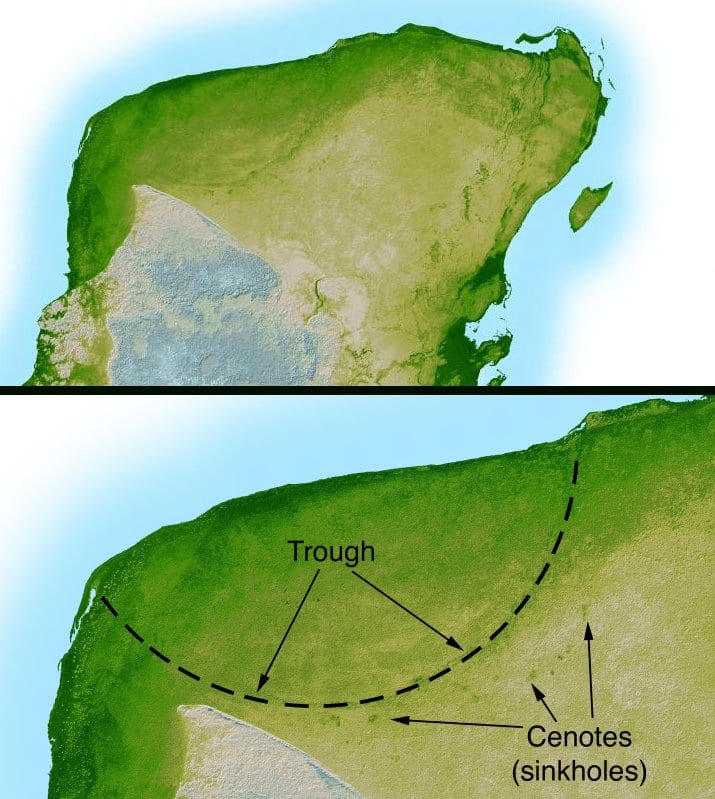
The scar. Shuttle radar topography of the Yucatán Peninsula. The faint arc is the buried rim of the Chicxulub crater, about 66 million years old. Image: NASA/JPL-Caltech, public domain.
XI · FEATHERS, COLOURS AND RE-WRITES
Birds are dinosaurs, and the picture keeps changing
In 1996 Chinese farmers in Liaoning province turned up Sinosauropteryx, a small theropod covered in simple filaments: the first non-avian dinosaur found with feather-like structures. Liaoning's fine volcanic ash then produced a stream of them: Caudipteryx, the four-winged Microraptor (2003), and in 2012 Yutyrannus, a nine-metre tyrannosaur relative covered in feathers. Filaments even turned up in some plant-eating ornithischians, which suggests that some kind of fuzz might go back close to the origin of dinosaurs.
The debate Heilmann had closed is over. Birds are dinosaurs: a surviving branch of the theropods. There are roughly 11,000 species of dinosaur alive right now, and one of them may be on your windowsill. The "extinction of the dinosaurs" was really the extinction of the non-avian ones.
Then came what earlier generations would have called impossible:
- Colour. In 2010, researchers compared fossil melanosomes (pigment-carrying cell structures) with those of living birds and reconstructed real colours: Sinosauropteryx had a reddish-brown banded tail, Anchiornis black-and-white wings with a rusty crest.
- Soft tissue. In 2005 Mary Schweitzer reported flexible, vessel-like structures inside a T. rex femur, and a controversy over molecular preservation began that still hasn't been resolved.
- Reclassification. In 2017 a Cambridge team proposed redrawing the base of the dinosaur family tree (the "Ornithoscelida" hypothesis), and the argument is still going on. Since 2014, Spinosaurus has been at the centre of a fierce dispute about whether it was a swimming, semi-aquatic predator.
- Nanotyrannus. For decades, small tyrannosaur skulls from Montana were treated as juvenile T. rex, and whole models of how T. rex grew up were built on them. In October 2025, Lindsay Zanno and James Napoli published in Nature their study of the "Dueling Dinosaurs" fossil (a tyrannosaur preserved alongside a Triceratops) and concluded that Nanotyrannus was a separate, fully grown species living at the same time as T. rex. They also named a second species. Not everyone accepts all of it, but a large body of T. rex research now has to be rechecked.
New species are now named at a rate of roughly one a week. More dinosaurs have been described in the last thirty years than in the previous 170 put together.
XII · WHAT THE STORY TEACHES
A history of being usefully wrong
Seen from a distance, the history of dinosaur knowledge isn't a straight line from ignorance to truth. It's a sequence of confident frameworks, each one making some things visible and hiding others:
- Giants and dragons could see a bone but not an animal.
- Figured stones could see a shape but not a life.
- Cuvier's catastrophes could see extinction but not descent.
- Owen's dinosaurs could see a group but read it as an argument against evolution.
- The mid-century "loser" reptiles could see size but not behaviour.
- The Renaissance could see activity, and sometimes saw more of it than was there.
Each of these was "registered ignorance" in its own way: on record, in print, illustrated and taught. Plot's giant man, Brookes's scrotum, Hitchcock's birds, Mantell's horn, Cope's backward plesiosaur, Owen's rhinoceros-Iguanodon, the egg-thief that was a mother. None of them were stupid. Each worked properly with what the evidence and the categories of the time allowed. What sets science apart isn't that it avoids mistakes. It's that it keeps the record of them, so the next person can find them and fix them.
The dinosaurs at Crystal Palace are wrong in nearly every detail, and that is exactly why they're preserved: a monument to what we once were sure of.
The animals didn't change. Our eyes did. There is little reason to think we're finished.
TIMELINE
The discovery of dinosaurs at a glance
| Year | Event |
|---|---|
| 4th c. CE | Chang Qu records "dragon bones" at Wucheng, Sichuan, possibly the earliest written mention of dinosaur fossils |
| 1665–1669 | Hooke argues fossils were once alive; Steno shows "tongue stones" are shark teeth and sets out the principles of stratigraphy |
| 1677 | Robert Plot illustrates the end of a Megalosaurus femur and identifies it as a giant human's |
| 1763 | Richard Brookes labels Plot's bone "Scrotum Humanum" |
| 1796 | Cuvier demonstrates that species go extinct |
| 1802 | Pliny Moody finds three-toed tracks in Massachusetts: "Noah's raven" |
| 1811–1823 | Mary Anning finds the first recognised ichthyosaur and the first complete plesiosaur |
| 1822 | Mosasaurus named from the Maastricht skull |
| 1824 | Buckland names Megalosaurus, the first non-avian dinosaur |
| 1825 | Mantell names Iguanodon |
| 1830 | De la Beche paints Duria Antiquior |
| 1842 | Owen coins Dinosauria |
| 1853–54 | Dinner inside the Iguanodon mould; Crystal Palace dinosaurs open |
| 1858 / 1868 | Hadrosaurus found in New Jersey; mounted as the first standing dinosaur skeleton |
| 1859–1861 | Darwin's Origin of Species; Archaeopteryx discovered |
| 1868 | Huxley links birds and dinosaurs |
| 1877–1892 | The Bone Wars: Cope and Marsh name roughly 140 species |
| 1878 | Bernissart Iguanodons: the "horn" turns out to be a thumb |
| 1905 | Tyrannosaurus rex named |
| 1923 | First widely accepted dinosaur eggs found in the Gobi |
| 1926 | Heilmann rejects a dinosaur ancestry for birds |
| 1969 | Ostrom names Deinonychus; the Dinosaur Renaissance begins |
| 1979 | Horner names Maiasaura; evidence of parental care |
| 1980 | Alvarez iridium hypothesis |
| 1991 | Chicxulub identified as the impact crater |
| 1996 | Sinosauropteryx: the first feathered non-avian dinosaur |
| 2010 | First dinosaur colours reconstructed from melanosomes |
| 2015 | Brontosaurus reinstated as a valid genus |
| 2024 | The griffin–Protoceratops hypothesis is challenged |
| 2025 | Nanotyrannus shown to be a distinct species, not a young T. rex |
Sources
1. "History of paleontology" and "Dinosaur" (history of study), Wikipedia. en.wikipedia.org
2. "Megalosaurus," Wikipedia (Plot, Lhuyd, Brookes, Buckland). en.wikipedia.org
3. Linda Hall Library, Paper Dinosaurs 1824–1969 digital exhibition (Buckland, Mantell, early restorations, Hadrosaurus). lindahall.org
4. Natural History Museum, London, "The discovery of Iguanodon." nhm.ac.uk
5. UCL Museums, "Gideon Mantell's Iguanodon bones." blogs.ucl.ac.uk
6. University of Cambridge, "Iggy the Iguanodon and the 160-year-old dinosaur song" (Crystal Palace banquet). cam.ac.uk
7. UC Museum of Paleontology, "Early Dinosaur Discoveries" (Leidy and Hadrosaurus). ucmp.berkeley.edu
8. Witton, M. P. & Hing, R. (2024), "Did the horned dinosaur Protoceratops inspire the griffin?" Interdisciplinary Science Reviews; University of Portsmouth summary. port.ac.uk
9. Zanno, L. E. & Napoli, J. G. (2025), "Nanotyrannus and Tyrannosaurus coexisted at the close of the Cretaceous," Nature; coverage in National Geographic. nationalgeographic.com
10. "Charles R. Knight," Wikipedia, and Linda Hall Library, "Scientist of the Day: Charles Knight." lindahall.org
Further reading: Adrienne Mayor, The First Fossil Hunters (2000); Deborah Cadbury, The Dinosaur Hunters (2000); Steve Brusatte, The Rise and Fall of the Dinosaurs (2018); Martin Rudwick, Bursting the Limits of Time (2005).
Images: historical illustrations and photographs are public domain via Wikimedia Commons; the Crystal Palace photograph is by Jes from Melbourne (CC BY-SA 2.0); the Chicxulub image is NASA/JPL-Caltech.